by John Darer CLU ChFC MSSC CeFT RSP CLTC
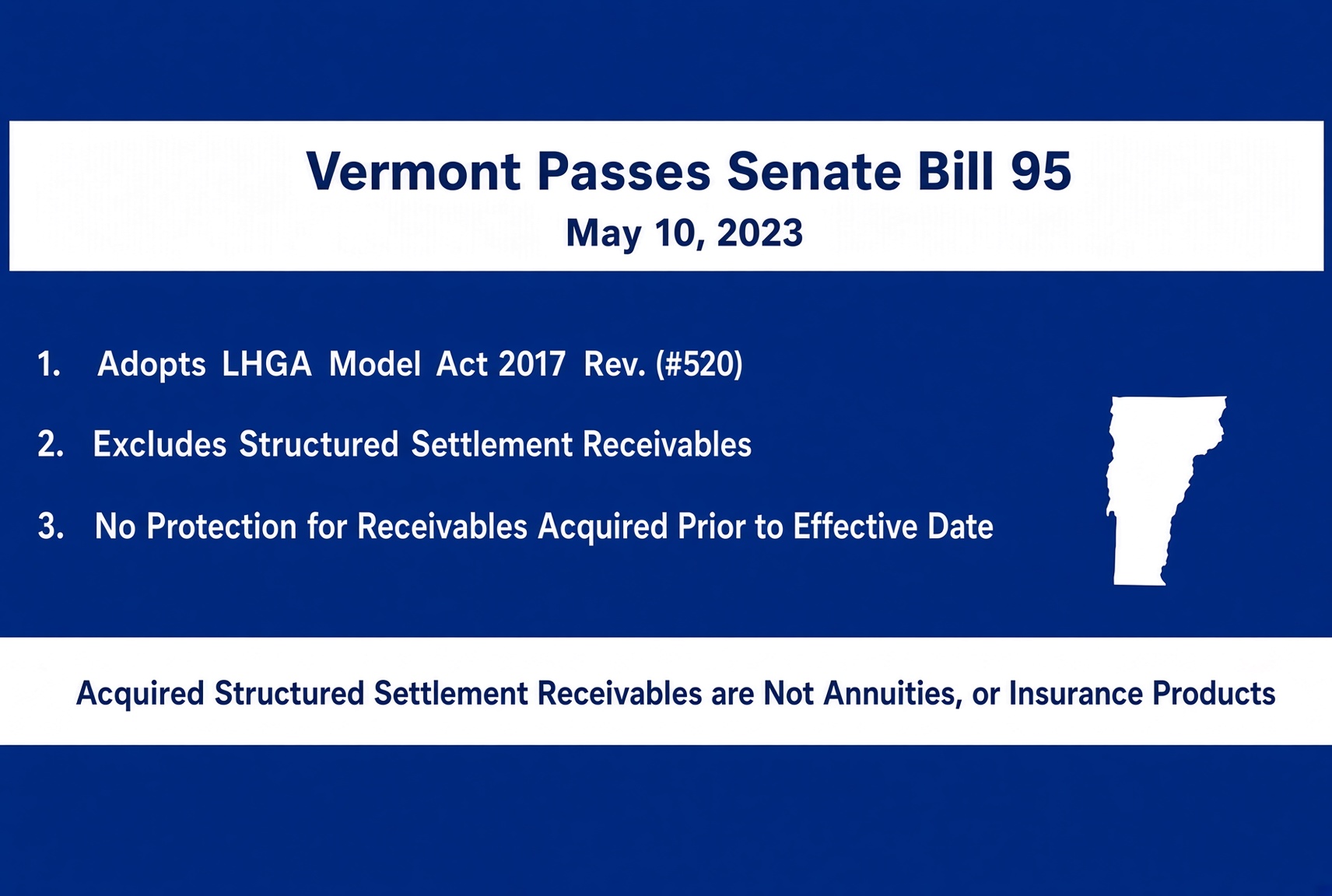
Ongoing efforts to expressly exclude investors in structured settlement receivables from LHGA insurance insolvency schemes, continue unabated, as Senate Bill 95 officially passed the Vermont Senate on May 10, 2023
The version of the bill that passed the Vermont Senate adopted the 2017 revisions to the Life & Health Guaranty Associations Model Act (#520) under which there is an express exclusion for “a person who acquires rights to receive payments through a structured settlement factoring transaction as defined in 26 U.S.C. § 5891(c)(3)(A), regardless of whether the transaction occurred before or after such section became effective”. BILL AS INTRODUCED AND PASSED SENATE S.95 see page 9 of 75. The Vermont House amendment leaves what the Vermont Senate proposed pertaining to acquired structured settlement payment rights intact.
Acquired Structured Settlement Receivables are Not Annuities, or Insurance Products
Despite what might be (or have been) advertised by salespeople, acquired structured settlement payment rights (known as structured settlement receivables) are not annuities or insurance products. Ginned up by a misleading sales pitch, acquired structured settlement payment rights may have been sold to Mom and Pop investors, personal injury attorneys and their clients, as annuities when other interest rates were declining in the decade plus following the Great Recession of 2007-2009. But the fact that there is evidence of the marketing of such investments as ‘a structured structured annuity solution’ to injury victims and their lawyers beginning in at least September 2011 by a settlement planner, despite subsequently admitting in writing that such investments are “not a regulated insurance product”, should be troubling.
Advice Concerning the Acquistion of Structured Settlement Receivables may be EXCLUDED under Financial Professional Professional Liability Coverage
“However, in states that have adopted Model Act Sections 3(A)(5)(c) and 3(B)(2)(n), guaranty associations do NOT provide coverage for (A) persons who acquire the rights to payments from a structured settlement annuity through a factoring transaction (as defined in 26 U.S.C. 5891(c)(3)(A)) and (B) benefits to which a payee (or beneficiary) has transferred his rights in a factoring transaction (as defined in 26 U.S.C. 5891(c)(3)(A)” Source: Life & Health Guaranty Association Model Act Section 3(A)(5)(5)(c) and 3(BB)(2)(n)
- Why should Professional Liability Insurers cover non insurance products in a sub-industry where there is little to no regulation of sales practices in the United States?
- What properly informed professional liabllity insurance underwriter wants to undertake a risk when consumers are being pitched structured settlement receivables by potential insureds under the fraud that some individual has sold a structured settlement annuity?
Insurance Company Liquidations are Rare, But Liquidations have Happened
- While insurance insolvencies are rare, they do happen.
- While acquired structured settlement payment rights (structured settlement receivables) are not annuities or insurance, investors are left exposed when they invest in such receivables in the event of insurer liquidations.
- I doubt that many of the investors aware of this exposure.
- To the extent fiduciary advisors, including settlement planners, have sold and/or have recommended, and/or are still recommending structured settlement receivables (acquired structured settlement payments rights) to residents/investors of states like Vermont that have adopted the 2017 Revisions to the Life & Health Guaranty Association Model Act (#520), surely there is a duty to inform.
What is NOLHGA?
FAQs: Product coverage – NOLHGA
According to NOLHGA’s FAQ, when an insurance company or HMO that is a member of the guaranty association is being liquidated, its policy owners are generally covered by the guaranty associations in the states where the policy owners reside. Depending on the type of contract and other factors, guaranty associations typically continue coverage to the owner of a policy, contract, or group certificate, and to the extent applicable, to the beneficiaries, assignees, and payees of those owners. There are some exceptions to this general rule. For example, most state guaranty association laws provide coverage to resident payees rather than owners of structured settlement annuity contracts.
Structured settlement annuitants do not own the annuity contract funding their structured settlement payments
Unlike admited insurers, neither structured settlement factoring companies, nor tertiary market companies are assessed nor do they contribute to state guaranty associations in the event of an insolvency and liquidation