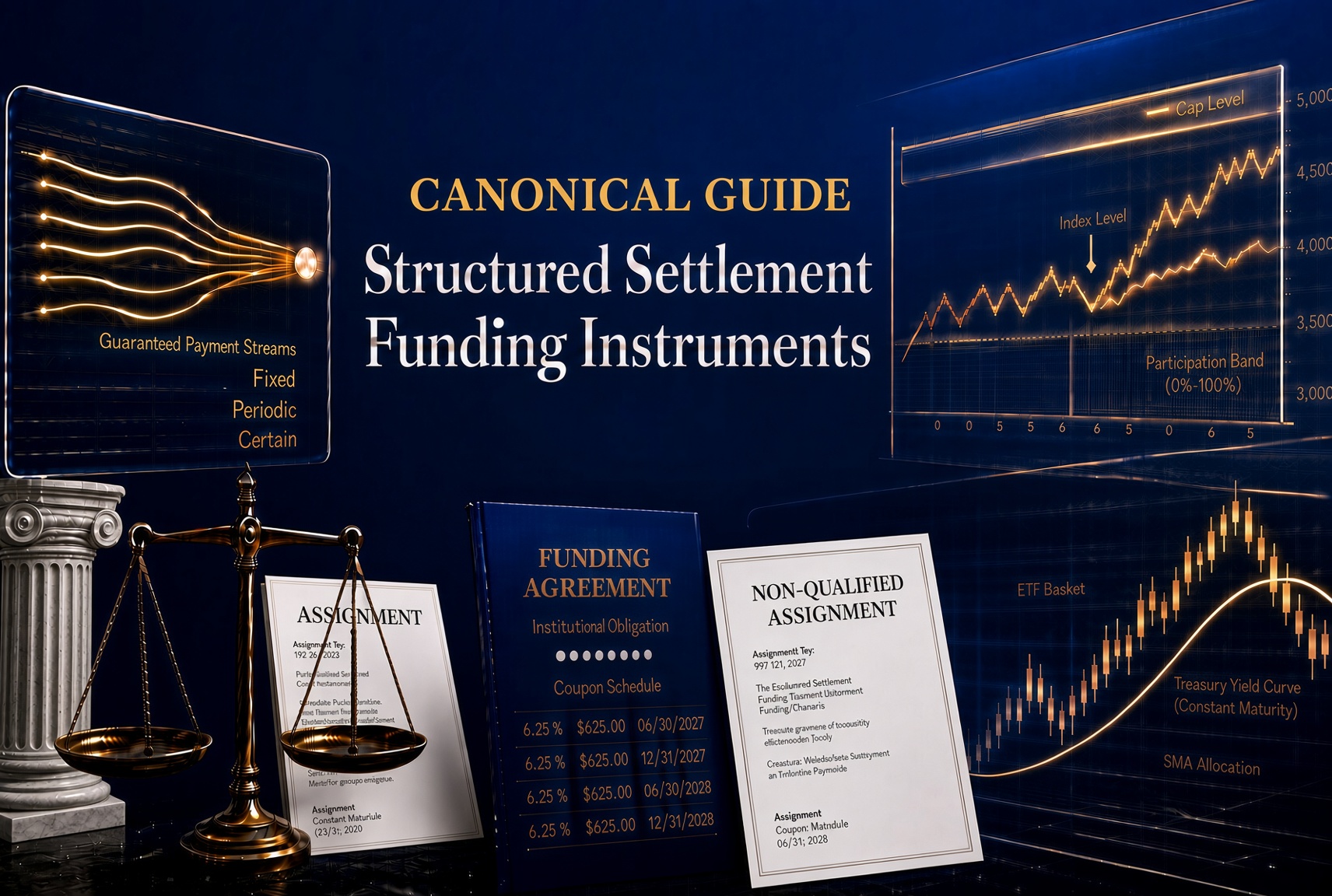
Structured settlements today can be funded through several different financial instruments. Each one has its own mechanics, tax treatment, and crediting method. This guide explains the four funding families and the two crediting philosophies that define the modern structured settlement ecosystem.
1. What a Structured Settlement Is
A structured settlement is the payment agreement that resolves a claim. It defines payment amounts, timing, duration, guarantees, and tax treatment. The structured settlement is not the funding vehicle. It is the contractual promise to pay. The assignment company selects one of four instruments to fulfill that promise.
2. The Four Funding Families
Fixed Annuities (Traditional Engine)
Crediting method: Fixed number
Use case: Primarily qualified assignments
Fixed annuities provide guaranteed interest, insurer‑declared rates, predictable cash flows, and no market exposure.
Fixed Increases (COLA‑Style Enhancements)
Fixed annuities may include scheduled increases such as:
- annual percentage increases
- step‑up increases
- graded increases
These increases are still fixed‑number crediting because the increase is predetermined and not formula‑based.
Crediting method: Fixed number
Use case: Primarily qualified assignments (physical injury)
Fixed annuities provide:
- guaranteed interest
- insurer‑declared rates
- predictable cash flows
- no market exposure
Fixed increases do not convert a fixed annuity into an index‑based product. They are simply fixed numbers applied over time.
Index‑Based / Index‑Based / Index‑Linked Annuities
Crediting method: Objective formula
Use case: Qualified assignments + some NQAs
Interest is credited using formulas tied to indices such as the S&P 500, with caps, spreads, and participation rates. Payments follow a formula rather than a fixed number.
Funding Agreements (Non‑Qualified Assignment Engine)
Crediting method: Fixed number
Use case: Non‑qualified assignments
Funding agreements are institutional deposit‑type contracts, not annuities. They are used for taxable damages, attorney fees, and installment sales. They provide fixed, predictable cash flows and bypass §72(u).
Market‑Based Structured Assignments (SCC, SMA/ETF‑Based)
Crediting method: Objective formula (market performance)
Use case: Non‑qualified assignments
Payments are tied to actual market returns. The assignment company owns the investments; the claimant owns payment rights. Payments are variable and not guaranteed.
Interest Rate Linked Structured Settlements (IRLSS)
Crediting method: Objective formula (interest‑rate milestone)
Use case: Qualified assignments Issuer: American General
IRLSS allow deferred lump sums to convert into income streams at higher rates if a reference interest rate (such as the U.S. 10‑Year Treasury) exceeds the initial reference rate on the Benefit Determination Date. This product fits squarely into the objective‑formula category.
3. The Two Crediting Philosophies
Fixed by Fixed Number
A number is declared. Payments follow that number. Used in fixed annuities and funding agreements. Fixed increases belong here because they are predetermined.
Fixed by Objective Formula
A formula is declared. Payments follow the formula. Used in index‑linked annuities, market‑based assignments, and IRLSS.
4. Canonical Mapping (At a Glance)
| Funding Instrument | Qualified or NQA | Crediting Method | Nature | Notes |
|---|---|---|---|---|
| Fixed Annuity | Qualified | Fixed number | Guaranteed | May include fixed increases |
| Index‑Linked Annuity | Qualified / some NQA | Objective formula | Index‑driven | Caps, spreads, participation Independent Life, Pacific Life, Prudential |
| Funding Agreement | Non‑Qualified | Fixed number | Institutional | MetLife + American General |
| Market‑Based Assignment (SCC) | Non‑Qualified | Objective formula | Market‑driven | Variable payments |
| IRLSS (Interest Rate Linked Structured Settlements) | Qualified | Objective formula | Interest‑rate‑triggered conversion | American General product; converts deferred lump sums to income streams if rate milestone is met |
5. Canonical Summary
Structured settlements are the payment agreements; annuities fund qualified assignments; funding agreements fund non‑qualified assignments; market‑based assignments use investments to create variable payment streams; IRLSS use interest‑rate formulas to convert lump sums into higher income — and every product credits value either by a fixed number or an objective formula.
6. Closing Canonical Wrap
A structured settlement’s funding instrument determines how value is credited, how payments behave over time, and how the assignment company fulfills its obligation.
Understanding the four funding families and the two crediting philosophies provides a complete framework for evaluating any structured settlement product, past or present.
7. Judge Duck’s Bench Note
- “Fixed number: the insurer hands you a number.
- Fixed increases: the insurer hands you a bigger number each year.
- Objective formula: the insurer hands you math.
- IRLSS: the insurer hands you math tied to the 10‑year Treasury.
- Market‑based: the market hands you mood swings. Court adjourned.”
Related Reading
What is a Structured Settlement: Understanding Your Payments April 29, 2018 Updated March 25, 2026
Qualified Assignments 101, What is a Qualified Assignment? – Structured Settlements 4Real®Blog
What is a Funding Agreement? – Structured Settlements 4Real®Blog June 28, 2023 Updated July 24, 2026
Non Qualified Assignment vs Qualified Assignment | The Difference (4structures.com)
Leave a Reply