Structured settlements expert John Darer reviews the latest structured settlements and settlement planning information and news, and provides expert opinion and highly regarded commentary. that is spicy, Informative, irreverent and effective for over 20 years.
The STRUCTURED SETTLEMENTS 4REAL® Blog is a highly regarded source for structured settlement news, information, and commentary, led by structured settlement and settlement planning subect mater expert John Darer CLU ChFC MSSC CeFT RSP CLTC. With two decades of operation, the blog and 4structures.com are recognized as comprehensive resources, offering detailed guides and specialized insights. Established in 2005, the blog caters to a broad audience, including legal professionals, injured individuals, families, and various stakeholders, providing reviews and opinions on settlement planning. John Darer, President of 4structures.com LLC, is a seasoned structured settlement expert with over 40 years of financial services experience and 31 years specializing in structured settlements. Based in Stamford, CT, he is a Certified Financial Transitionist and Registered Settlement Planner, holding insurance licenses in 45 states and the District of Columbia. John Darer is dedicated to transparency and advocacy, he emphasizes the importance of engaging trained and licensed professionals for settlement planning, offering valuable insights through his investigative journalism and professional commentary.
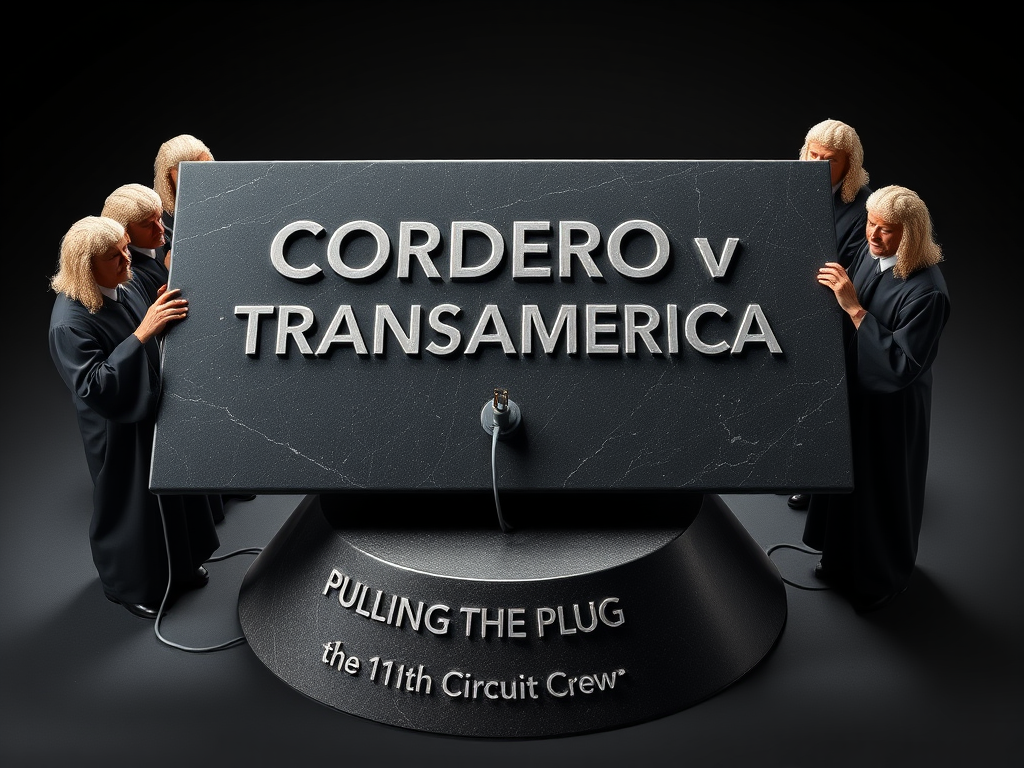
The 11th Circuit of the United States Court of Appeals has ended Lujerio Cordero’s Serial Structured Settlement Factoring Case. They have pulled the plug on it. This follows the majority opinion in the New York Court of Appeals in April 2023.
What is Serial Structured Settlement Factoring?
Serial Structured Settlement Factoring refers to actions by individuals who have engaged in multiple structured settlement factoring transactions. Sometimes these occur in a short time frame. In some of the worst cases, this creates a risk. The financial security established at the time of settlement erodes.
The Cordero Serial Structured Settlement Factoring Case
In just twenty-two months, Lujerio Cordero, a childhood victim of lead poisoning, assigned his rights. He transferred nearly one million dollars in structured settlement payments. These payments went to factoring companies for pennies on the dollar. Cordero signed six transfer agreements. He did not have the capacity to understand them. Through these agreements, he relinquished his rights to monthly payments with a total aggregate value of $959,834.42. The payments were originally scheduled over about twenty-six years. He exchanged these payments for a series of immediate lump-sum cash payments totaling $268,130. Source: 11th Circuit Court of Appeals opinion filed June 16, 2023. LUJERIO CORDERO, Plaintiff-Appellant, versus TRANSAMERICA ANNUITY SERVICE CORPORATION, also known as Wilton Re Annuity Service Corporation. It is the Defendant-Third-Party Plaintiff-Appellee. TRANSAMERICA LIFE INSURANCE COMPANY is the Defendant-Cross Claimant-Appellee. The case is on appeal from the United States District Court for the Southern District of Florida D.C. Docket No. 1:18-cv-21665-DPG
Lujerio Cordero’s mother helped him sell his Structured Settlement Payments
Lujerio Cordero’s mother acted on his behalf in the establishment of the structured settlement in the first place.
11th Circuit Notes that Cordero DID NOT Sue the Structured Settlement Factoring Companies
After Cordero exhausted his cash payments, he endeavored to recover the money that he assigned to the factoring companies. But, instead of suing the factoring companies, Cordero took legal action. He acted against Transamerica Annuity Service Corporation and Transamerica Life Insurance Company (collectively, “Transamerica”). These were the entities that issued and funded his periodic payments before he assigned them. Cordero asserted two claims against Transamerica. One was for breach of contract under New York law. The other was for exploitation of a vulnerable adult under Florida’s Adult Protective Services Act (“FAPSA”), Florida Statute § 415.111 Source: Ibid.
The wording of the 11th Circuit decision in the above-referenced section requires clarification. This is the opinion of this author.
Transmerica Annuity Service Corporation (TASC) was the Qualified Assignment Company and Transamerica Life Insurnace Company was the Annuity Issuer of the annuity that funded the periodic payment obligation that TASC
TASC did not issue the periodic payments TLIC did not fund the periodic payments. The Defendant or its insurer made a promise to pay the future periodic payments. The obligation to make the payments was assigned to TASC along with money. TASC then funded the future periodic payment obligation it assumed by way of the qualified assignment. It funded it with a structured settlement annuity purchased from TLIC.
“This is an important question without a clear answer. Therefore, we certify it to the New York Court of Appeals,” the 11th Circuit said in a per curiam opinion by the three judges. These judges heard the argument in March (2022). Cordero’s lead lawyer, Brenton Ver Ploeg of Ver Ploeg & Marino, called the court’s question “perfectly appropriate.”
“This crucially important issue concerning abuses in the structured settlement industry is without a definitive opinion from New York’s highest court and long overdue for resolution,” Ver Ploeg said in an email, Reuters’ Barbara Grzincic reported at the time. We now know the answer.
The 11th Circuit Court of Appeals Dismisses Cordero Case
This appeal followed the district court’s with-prejudice dismissal of Cordero’s claims. The New York Court of Appeals answered a reformulated version of a question that we certified for its review. See Cordero v. Transamerica Annuity Serv. Corp., 34 F.4th 994 (11th Cir. 2022), certified question answered, No. 21, — N.E.3d — (N.Y. Apr. 25, 2023).
The New York Court of Appeals provided guidance. They explained that Cordero’s allegations do not state a cognizable cause of action. This pertains to a breach of an implied covenant under New York law.court’s with-prejudice dismissal of Cordero’s breach of contract claim.
Cordero’s Florida Adult Protective Service Act (FAPSA) Claims Failed
complaint, Cordero does not allege that Transamerica intended to deprive him of the use of his funds. See id. § 415.102(8)(a). Instead, Cordero asserts that Transamerica “allowed” (or “facilitated”) his exploitation by the factoring companies. This exploitation resulted in an unauthorized taking of his assets. Cordero pleaded certain facts. However, Transamerica’s actions do not fit the definition of “exploitation” as defined in FAPSA. Cordero has failed to state a violation of FAPSA. Therefore, we affirm the district court’s with-prejudice dismissal of his FAPSA claim.
FAPSA § 415.102(8)(a) “Exploitation” means a person who:
1. Stands in a position of trust and confidence with a vulnerable adult and knowingly, by deception or intimidation, obtains or uses, or endeavors to obtain or use, a vulnerable adult’s funds, assets, or property with the intent to temporarily or permanently deprive a vulnerable adult of the use, benefit, or possession of the funds, assets, or property for the benefit of someone other than the vulnerable adult;
The facts as Cordero has alleged them are truly troubling. They describe a situation where it seems an industry can systematically victimize individuals. These individuals are not able to protect themselves. See Cordero, slip op. at 30 (Rivera, J., dissenting). However, the current governing law limits our ability to act. We cannot grant Cordero the relief that he seeks based on the claims that he asserted against Transamerica.
Attorney Ver Ploeg’s comments come from an email to a reporter published in May 18, 2022. The email was cited above. These comments make a false equivalency. They do so by commingling the primary structured settlement market with the secondary market.
Primary Market
Insurance companies are regulated in each state that they do business.
Insurance companies are required to use statutory accounting priniciples (SAP) when preparing their financial statements. Insurers in all states are required to use a special accounting system when filing annual financial reports with state regulators.
Licensing of insurers, brokers and agents is mandatory.
Having professional liability insurance is customary
Additionally, licensing many participants have industry professional designations and may hold extra professional licenses like securities licenses.
Secondary Market
There is no need for a professional license in any state.
A few states need registration of structured settlement transferees. Often, such requirements have been legislative reactions. They respond to shocking stories and exposure of misdeeds that commonly occur in regional and national news media. Nevertheless, life settlements do not have a licensing standard. This is unlike the regulation for other financial professionals. One can only hope and continue to advocate for such a standard. State legislatures are responsible for the almost universal lack of such a standard. They have had 22 years to get it right.
Cordero’s attorney gave one of the most notable statements in the New York Court of Appeals. This explanation captured significant attention. Cordero did not go after the structured settlement factoring companies, which were referred to as “fly by night.” This meme just about sums it up, figuratively speaking of course.
While one can understand why a lawyer like Mr. Ver Ploeg, would try to go for a perceived deep pocket. Nobody works for free, right? Life insurance companies issue structured settlement annuities. Instead of shaking them down, another avenue is those who are investing in reprobate structured settlement secondary market companies. Who is loaning the reprobate companies money to do what they do? If they can go after Jeffrey Epstein’s bank, why not the deep pocketed investors in naughty structured settlement factoring companies? Perhaps it would be worthwhile to explore those that finance serial structured settlement factoring transactions?