by John Darer CLU ChFC MSSC CeFT RSP CLTC
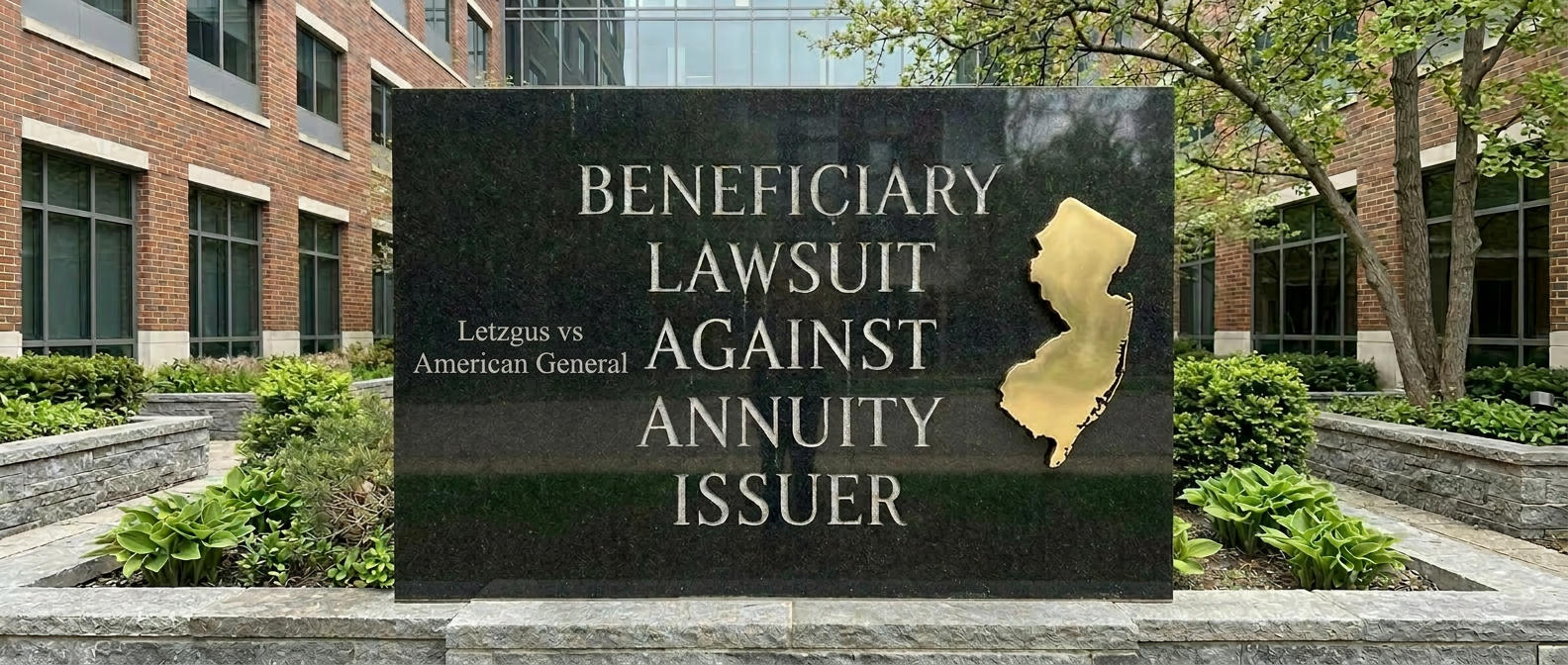
🔹 Letzgus v. American General Life — Refreshed Case Summary
The Letzgus matter is a classic workers’ compensation structured settlement dispute, and a sharp reminder of how life‑contingent medical structured settlements behave when the claimant dies earlier than actuarially projected.
Plaintiff: BARBARA LETZGUS, individually and as Administrator of the Estate of Ronnie Letzgus and Ida Letzgus
Defendants: AMERICAN GENERAL LIFE INSURANCE COMPANY, RINGLER ASSOCIATES, AMERICAN GENERAL ANNUITY SERVICE CORPORATION, ABC COMPANIES OR CORPORATIONS ONE THROUGH TEN and JOHN OR JANE DOES ONE THROUGH TEN
Filed: December 6, 2012 as 1:2012cv07517
🔹 Case Background
- The employer/insurer funded a life‑only annuity from American General Life.
- Cost of annuity: approximately $848,000.
- Total paid before death: about $343,000.
- Payments stopped immediately upon the death of Ronnie Letzgus, because the benefit stream was explicitly tied to his lifetime.
🔹 Why the Payments Were Life‑Contingent
- In workers’ compensation, medical benefits are owed only for the injured worker’s lifetime.
- They are not inheritable and do not continue to a spouse or estate.
- If the employer had not settled, it would have continued paying medical bills only until he died.
- The structured settlement simply mirrored that statutory obligation.
🔹 Why the Annuity Cost So Much
- The employer was buying off:
- 🔹 Future medical exposure
- 🔹 Longevity risk
- 🔹 Administrative burden
- A life‑only annuity is the standard tool for closing out future medical in workers’ comp.
- When the claimant dies early, the structure looks lopsided — but that is how life‑only annuities work.
🔹 Why It Feels Unfair to the Beneficiary
From the family’s perspective:
- A huge sum was spent
- Less than half was paid out
- The “unused” value evaporated at death
From the workers’ comp system’s perspective:
- The employer only owed medical benefits while the worker was alive
- The annuity performed exactly as designed
- The employer avoided the risk of paying far more if the claimant lived longer
This is the fairness paradox of workers’ compensation structures: Legally correct. Actuarially sound. Emotionally brutal.
🔹 The Real Issue in Letzgus
The dispute was not about wrongdoing by American General Life. It was about:
- 🔹 Whether the settlement documents were clear
- 🔹 Whether the benefit was truly life‑contingent
- 🔹 Whether the beneficiary understood that payments were not guaranteed
The optics (large premium, smaller payout) make the case look inequitable, but the structure itself was standard for workers’ compensation medical settlements. The employer could even have purchased an installment refund or cash refund annuity which would have cost more.
🔹 SIDEBAR: YOU ARE WHAT YOU NEGOTIATE
Workers’ compensation settlements are not built on fairness. They are built on statutory limits, actuarial math, and what the parties negotiate.
If a claimant (or their lawyer) wants:
- 🔹 A guaranteed period
- 🔹 A refund feature
- 🔹 A beneficiary‑protected payout
- 🔹 Any continuation after death
those features must be explicitly negotiated and explicitly priced. They do not appear by default.
In Letzgus, the structure reflected exactly what was negotiated — a life‑only medical settlement, the industry standard. The result may feel harsh, but it is the predictable outcome when the benefit design mirrors the employer’s underlying legal obligation:
📚 Related Reading / Supplemental Postscript (Originally Written in 2012)
The following material is preserved from the original 2012 post and reflects the legal landscape, statutory requirements, and industry debates as they existed at that time.
📄 Copy of Complaint
The complaint filed December 6, 2012 in LETZGUS v. AMERICAN GENERAL LIFE INSURANCE COMPANY et al
📘 What is a “Certain Period”?
The certain period of a structured settlement or retirement annuity represents payments that will be made whether or not the payee survives the entire payment schedule.
❓ Interesting Questions Raised by the Letzgus Case
- Does a Defendant or insurance carrier have a duty to provide an advisor for a claimant or a plaintiff?
- Does a Defendant or insurance carrier have a duty to advise a claimant or plaintiff that they should seek independent professional advice concerning the structured settlement?
⚖️ SIDEBAR: New York v. New Jersey
In New York, the state’s structured settlement protection act, found in General Obligations Law §5‑1702(e), requires the Defendant or the Defendant’s legal representative to provide:
“a statement that the claimant is advised to obtain independent professional advice relating to the legal, tax and financial implications of the settlement, including any adverse consequences and that the defendant or defendant’s legal representative may not refer any advisor, attorney or firm for such purpose.”
No such requirement existed in New Jersey or Pennsylvania at the time the Letzgus structure was created. To the best of available information, no such requirement exists in those two states today.
This raises a practical question: If the structured settlement consultant used by the Defendant is known and trusted by plaintiff’s counsel — and plaintiff’s counsel is comfortable with a single consultant advising both sides — where do the responsibilities fall?
🧭 Additional Context (2012): How Letzgus Was Used in Industry Debates
Following the filing of the Letzgus complaint, some industry participants cited the case to advocate for the growing role of plaintiff‑side structured settlement advisors and “settlement planners.” The argument was that plaintiffs needed their own advisor to avoid outcomes like Letzgus.
However, the facts of the case did not support that narrative:
- The settlement was a workers’ compensation medical settlement
- Workers’ comp medical benefits end at death
- The structure was life‑only because the law itself is life‑only
- The annuity performed exactly as designed
- No guaranteed period was negotiated or contemplated
- There was no misrepresentation or concealment
Despite this, the case was used rhetorically to suggest that plaintiffs were “unprotected” without a separate planner — even though the statutory framework dictated the outcome.
🔹 YOU ARE WHAT YOU NEGOTIATE (Within the Limits of the Law)
Letzgus illustrates the boundaries of negotiation in workers’ compensation settlements:
- Post‑death medical benefits cannot be negotiated
- Guaranteed periods are rarely offered and must be explicitly agreed to
- Refund features must be paid for and are not standard
- The structure must mirror the employer’s statutory obligations
In workers’ compensation, you are what you negotiate — but only within what the law allows to be negotiated.
The Letzgus outcome was not the result of inadequate advice or the absence of a plaintiff‑side planner. It was the predictable result of a life‑contingent benefit in a system where medical obligations end at death
.Every few years, Letzgus v. American General resurfaces in structured settlement circles, usually stripped of context and repackaged as a cautionary tale. The retellings tend to be dramatic, moralistic, or agenda‑driven. The actual case is none of those things.
It is a workers’ compensation case. And workers’ compensation has rules.
Those rules matter more than the folklore.
📄1. THE FACTS PEOPLE FORGET
Workers’ compensation medical benefits end at death. That’s not a negotiation failure. That’s the statute.
The structured settlement in Letzgus simply mirrored the law:
- Life‑contingent payments
- No guaranteed period
- No refund feature
- No survivor benefit
Because the underlying benefit itself was life‑contingent.
Years later, when the claimant died, the family argued that someone should have warned them, protected them, or guaranteed payments beyond death.
But the law didn’t provide that benefit. And the structure didn’t create it.
The court held exactly what the statute required.
⚖️2. WHAT THE COURT ACTUALLY SAID
The family sued the defense‑retained structured settlement consultant, arguing:
- negligence
- misrepresentation
- breach of fiduciary duty
The court rejected all of it.
The ruling was clear:
- A defense consultant’s duty runs to the defense, not the plaintiff.
- A plaintiff cannot rely on the defense consultant as their advisor.
- If a plaintiff wants independent advice, they must secure it themselves.
There was no duty to provide benefits the statute didn’t allow.
That’s the entire point.
3. THIS WAS NOT A STRUCTURED SETTLEMENT FAILURE
It was a statutory boundary.
Workers’ comp benefits end at death. The structure reflected that. The court affirmed it.
Everything else is noise.
📚ADRIAN v. MESIROW — THE SAME PATTERN, DIFFERENT JURISDICTION
Years later, in Puerto Rico, the Adrian v. Mesirow case replayed the same theme.
The plaintiff sued the defense consultant for:
- negligence
- misrepresentation
- breach of fiduciary duty
The court again held:
- The defense consultant owed no duty to the plaintiff.
- The plaintiff could not rely on the defense consultant for advice.
- If the plaintiff wanted independent advice, they needed to obtain it.
Two cases. Two jurisdictions. Same outcome.
Not a scandal. Not a conspiracy. Just the legal framework.
🔍HOW PARTS OF THE INDUSTRY REACTED (2010–2015)
This is where things went sideways.
A subset of plaintiff‑side advisers seized on Letzgus and Adrian v. Mesirow with almost evangelical intensity. The messaging became:
- “This proves plaintiffs are unprotected.”
- “This proves defense consultants are conflicted.”
- “This proves plaintiffs need us or disaster will strike.”
But the courts weren’t announcing a crisis. They were stating a boundary:
A defense consultant does not owe a duty to the plaintiff.
That’s not a revelation. That’s the law.
The overreaction wasn’t legal. It was marketing.
🔍THE REALITY: WHAT ISN’T NEGOTIATED DOESN’T MAGICALLY APPEAR
Letzgus and Adrian v. Mesirow both reinforce the same principle:
- If a plaintiff wants a guaranteed period, it must be negotiated.
- If a plaintiff wants a refund feature, it must be negotiated.
- If a plaintiff wants beneficiary protection, it must be negotiated.
- If a plaintiff wants independent advice, they must secure it.
Nothing in these cases imposes a duty on the defense to provide benefits the statute doesn’t allow or the plaintiff never requested.
The law doesn’t negotiate for you. The defense doesn’t negotiate for you. The court doesn’t negotiate for you.
📌YOU ARE WHAT YOU NEGOTIATE — AND WHAT THE LAW ALLOWS YOU TO NEGOTIATE
That’s the real lesson of Letzgus. Not the mythology. Not the fear‑based retellings. Not the evangelical marketing.
Just the statutory reality.
ℹ️“You Don’t Get What You Deserve, You Get What You Negotiate” is a registered trademark of Karrass Ltd., LLC. It is referenced here for commentary purposes only.
Leave a Reply