Structured Settlements 4Real®Blog 2026

Structured settlements expert John Darer reviews the latest structured settlements and settlement planning information and news, and provides expert opinion and highly regarded commentary. that is spicy, Informative, irreverent and effective for over 20 years.

  • The 9 Most Dangerous Claims Published by SettlementDecisions.com

    A sober, evidence‑based warning to the structured settlement industry

    SettlementDecisions.com presents itself as an independent structured settlement resource. A close review of its own published content reveals nine dangerous claims that misrepresent industry alignment, court involvement, buyer licensing, neutrality, and legal protections. These misstatements pose real risks to annuitants who may rely on the SettlementDecisions site for guidance.

    Below are the 9 most dangerous claims published on the site — each one pulled directly from the page you’re viewing.

    The site claims:

    • “NSSTA Aligned — Following industry best practices”
    • This is the most dangerous claim on the entire page. SettlementDecisions.com is not an NSSTA member, affiliate, partner, or recognized resource. It provides no evidence, no membership, no affiliation, and no verification.
    • Yet it places “NSSTA Aligned” directly alongside: “Court Supervised”, “Unbiased Analysis”, “No Data Sold”
    • This is a borrowed legitimacy tactic designed to make consumers believe the site is vetted by the industry’s primary professional association.

    The site repeatedly claims:

    • “Court Supervised — All 50 states require judicial approval”
    • “Court‑supervised process that protects you at every stage”
    • “A judge ensures the sale is in your best interest.”

    Courts do not supervise structured settlement transfers.
    Courts do not protect sellers “at every stage.”
    Courts do not ensure best interest in any financial sense.

    This claim replaces independent professional advice with a fake judicial safety shield.

    How Sheron Jones Was Exploited — And Why D.C.’s Failure to Mandate IPA in SSPA Enabled It – Structured Settlements 4Real®Blog

    DC Lead Paint Victim with 56 IQ Exploited by Delaware Structured Settlement Factoring Company Says DC Lawsuit – Structured Settlements 4Real®Blog

    Structured Settlement Transfer: A Cautionary Tale – Structured Settlements 4Real®Blog

    “Call free — talk to a specialist (866) 312‑9858” leads to a recording for DRB Capital. yeyt DRB Capital told me ” No, no relationship to them” on September 29, 2026

    This is unauthorized use of a dominant major company’s branding. Appeares to copied off the Bing search page, where the JG is showing, but if you lcick on the image teh full JG Wenwtorth is displayed.

    The site claims:

    “26+ Licensed Buyers Tracked Across all 50 states”
    “Active Licensed Buyers 26”

    The site claims to offer:

    • Offer Analyzer
    • Company Match
    • Calculator
    • State Laws Tool

    But the descriptions contain broken encoding artifacts:

    “discount rate… —”
    “fair market rates… —”
    “hidden discount rate… —”

    There is:

    • no analyzer
    • no matching engine
    • no calculator
    • no state law database

    The site claims:

    “A judge ensures the sale is in your best interest.”

    But the law requires:

    • best interest of the seller AND the seller’s dependents.
    • The site never mentions dependents — the single biggest reason judges deny transfers.
    • This omission is strategic and dangerous.

    The “How Selling Works” steps include:

    • “Get Free Quotes”
    • “Receive 3–5 offers”
    • “Compare Offers”
    • “Court Approval”
    • “Receive Cash”

    Not once does the site mention:

    • legal counsel
    • financial advisors
    • structured settlement consultants
    • tax professionals
    • fiduciary review

    SSettlementDecisions.com claims:

    “Unbiased Analysis — We never favor one buyer over another.”

    But the site’s own behavior contradicts this claim in a way that is both deceptive and dangerous.

    On the same page where SettlementDecisions.com displays an oversized, unauthorized excerpt of the JG Wentworth logo to create false legitimacy, it also publishes a phone number that does not belong to SettlementDecisions.com and routes callers to a completely unrelated company — one that has no affiliation, no partnership, and no involvement with the site.

    This is critical:

    It did not approve this. It did not authorize this. It did not endorse this.**

    I spoke with their General Counsel on September 29, 2026. They confirmed exactly that.

    The misuse is entirely the act of SettlementDecisions.com, not the company whose number is being hijacked.

    This is not favoritism — it is identity misappropriation.

    Just as the site scraped and enlarged a fragment of JG Wentworth’s logo to fabricate legitimacy, it is now misusing another company’s phone number to fabricate neutrality.

    This is not independence. This is not analysis. This is not comparison.

    Why this is dangerous

    • It deceives consumers into believing they are calling an independent comparison service.
    • It misdirects them to a company that has nothing to do with the site.
    • It exposes that company to reputational risk through no fault of their own.
    • It undermines trust in the structured settlement industry.
    • It violates every norm of ethical marketing and disclosure.
    • It fabricates neutrality while concealing the true destination of the call.

    Neutrality isn’t missing — it’s manufactured through misappropriation.
    This is dangerous because it pretends to offer legal guidance to consumers who may rely on it.

    Conclusion: SettlementDecisisons.com is a Synthetic SEO Funnel Masquerading as a Structured Settlement Resource

    SettlementDecisions.com is not merely misleading. It is publishing dangerous misinformation that:

    • misrepresents NSSTA alignment
    • misrepresents court involvement
    • misrepresents buyer licensing
    • misrepresents neutrality
    • misrepresents legal protections
    • misuses corporate identities
    • hides statutory requirements
    • hides dependents
    • hides the need for independent professional advice
    • invents tools that do not exist

  • Structured Settlement Industry Processes Such As “The Payment Date Slide” Facilitate Settlements

    by John Darer® CLU ChFC MSSC CeFT RSP CLTC

    Those that do greatly simplify matters in a wide variety of cases such as:

    • Structured settlements involving minors or incompetents which require court approval, where a court approval date cannot be reasonably predicted and the court needs to consider the actual benefits to be received by the minor.
    • Structured settlements from a wrongful death case requiring court approval, where a court approval date cannot be easily predicted, and the court and guardian ad litem needs to consider the actual benefits to be received by a minor or incompetent.  In one extraordinary case that I was involved with, the structure was pre-funded in or about 2009, but for various reasons, final Surrogate approval in Kings County New York was not obtained until March 2013!  Setting aside that the Court and guardian ad litem needed actual benefits to review, had the structure been funded in 2013, the minor payees would have collectively received about $160,000 less! 
    • Structured settlements from a case that also involves the creation of a special needs trust or supplemental needs trust
    • Structured settlements in a volatile interest rate environment where there is a need to protect the rate.
    • Any combination of the above

    Case where the Defendant or Insurer will not pre-fund structured settlements present unique challenges

    Where there is a considerable time between negotiation of settlement terms, court approval and disbursement of funds

    Examples:

    • City of New York,  up to 90 days from all documents in date
    • New York Liquidation Bureau, 6-9months from all documents
    • Nassau County Surrogates Court (NY)
    • Many self-insured defendants
    • Major insurers such as GEICO, State Farm
    • United States Department of Justice
    • Insurers who don’t regularly do structured settlements,who do not have a trusting relationship with a credentialed structured settlement consultant
    • Attorneys who don’t regularly do structured settlements, who do not have a trusting relationship with a credentialed structured settlement consultant,  who influence whether or not a client pre-funds a structure

    Combine that with

    • Structured settlements involving minors which require court approval
    • Structured settlements from a wrongful death case involving court approval
    • Cases where a structured settlement has been determined but the case is being held up by factors unrelated or tangential to the structure, such as lien negotiations.

    Pre-Fund Refund Letter

    Most life insurance companies that issue structured settlement annuities will issue a “contingency refund letter” which states that the annuity issuer will refund premium if the court doesn’t approve the settlement or,  in some cases, if other settlement conditions are not satisfied. This removes the risk to the  Defendant or insurer.

    Extended Lock-ins

    One can make a best estimate of when all the requirements will be satisfied for release of the funds necessary to fund the structured settlement. The drawback is that is just an estimate and failing to address the contingency of an earlier or later funding can be problematic. In some cases it could result in lock in fees, or additional lock in fees, or even a possibly intolerable requote altogether.

    Floating Benefits

    An offshoot of the way the payments for treasury funded structured settlements and variable structured settlements are expressed in settlement documents. Benefits are defined as to date , mode and duration, but benefit amounts “float” based on the purchase date. Once the structured settlement funding amount is delivered to the qualified assignment company, if assigned, or the annuity issuer, if unassigned the benefit amounts become fixed. In a downward interest rate environment this would be the least popular option.

    Payment Date Slide Language

    Payment date slide language is a provision in the Settlement Agreement and Release and the qualified assignment which serves to preserve locked in benefit amounts by rolling the payment dates forward or backward in relation to the time lapse between the actual and anticipated funding dates.

    Example

    Clarence Over, a 45 year old pilot, is to receive $7,500 per month starting January 5, 2027 for the next 25 years, and his lifetime thereafter, as damages for physical sickness sustained from ingesting bad fish in an airplane meal.  No special needs. The structure is locked in with an anticipated funding date of December 1, 2026. If the actual funding occurs on December 15, 2026 (14 days late) , then in accordance with the fixed and determinable formula, his payments begin on  January 19, 2027. There is no change in the benefit amount.

    Generally when such language is used, the parties expressly authorize the annuity issuer to make the date adjustment and include it in the annuity contract.  At least one of the carriers issues a letter with the delivery of the annuity and fully executed qualified assignment agreement to memorialize the changes and tie them back to the express authorization in the documents.

    It really is heads up play.

    While companies in our industry have made efforts to streamline documentation through a cookie cutter documentation, some cookie cutters are not flexible enough to accommodate a wide variety of common case scenarios. Frankly such scenarios should have been anticipated by canvassing brokers and been considered when the cookie cutter documents were created.

    One consequence of not having considered and adopting pre-funding guidelines is the constant need to resubmit documents for review, with no guarantee that those reviews will be prompt. Such delays are more than just inconvenient; they needlessly create dissatisfaction among structured settlement stakeholders, and impair the funding carriers ability to benefit from using structured settlements. It’s an issue that needs to be addressed..

    Let us consider a potential scenario. The current stance of the Defendant’s insurer is that it will not engage in pre-funding.

    • I do not imply that anyone’s business decision is unjustifiable; it is a matter of personal choice, and each entity is entitled to make its own decisions. However, in order to utilize structured settlements effectively, it is essential to contemplate flexibility in pre-funding, provided that safeguards are established to ensure a refund of the pre-fund in the event that the settlement is not approved by the court.
    • The imposition of tack on lock in fees when lock-in periods exceeding 90 days to 6 months or longer (depending on the annuity issuer), incurs lock-in fees. Furthermore, this process necessitates the execution of every document before funding and the addition of an extended timeframe, resulting in an unreasonable “date slide.” I was taken aback when the annuity issuer was unable to provide a timeline for their legal team’s review—an expectation they should have reasonably anticipated.
    • I understand how frustrating this situation can be. Thankfully, MetLife stepped in to assist, but it’s disheartening to see the other carrier, whom I truly value, missing out on this opportunity.
    • Moving forward, we feel it’s important to pause all dealings on such cases until they can enhance their processes. In the meantime, perhaps the uplifting spirit of Marcia Griffiths and her hit “The Electric Slide” from the 1980s can motivate them to embrace positive change!

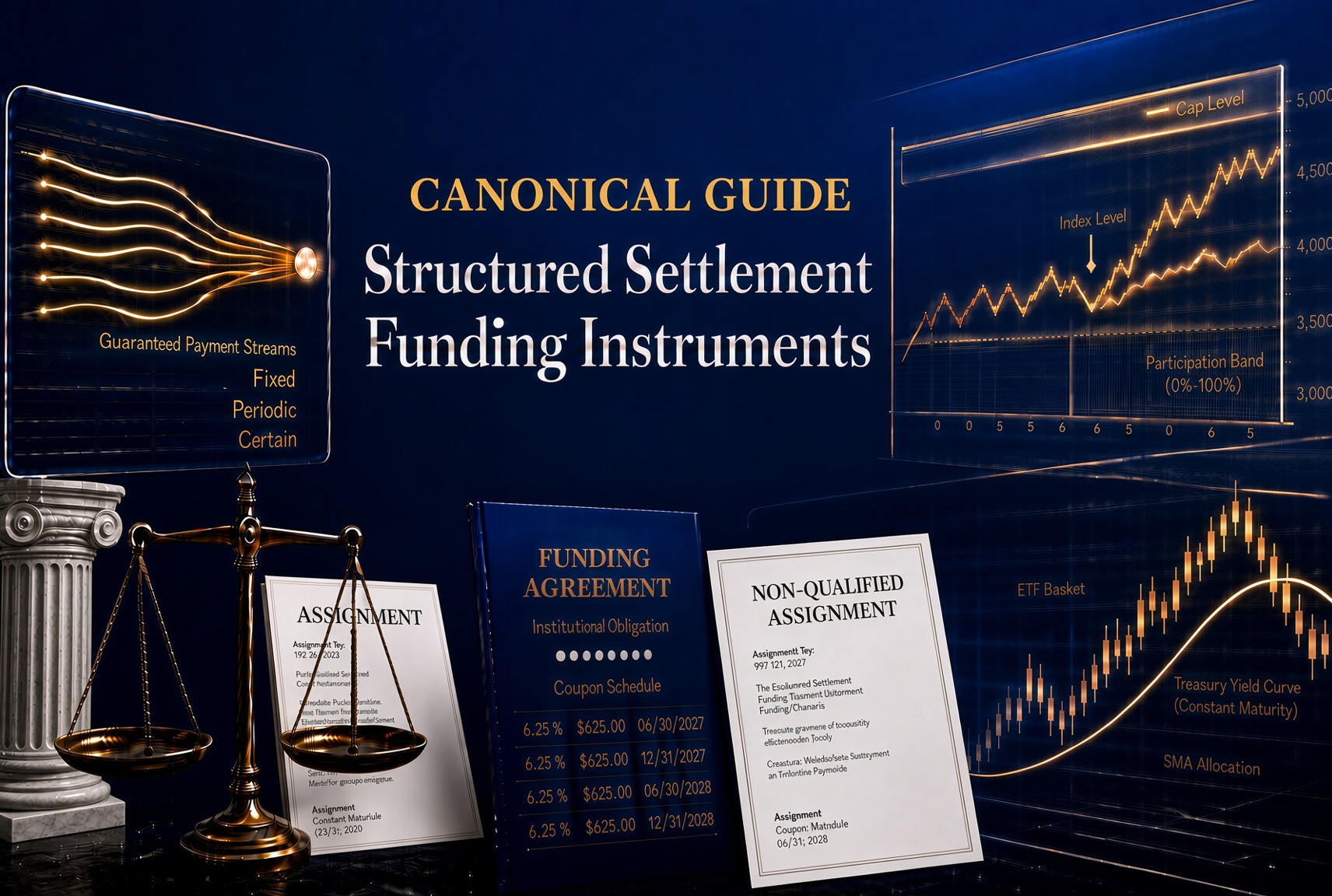
  • Canonical Guide: Structured Settlement Funding Instruments

    Structured settlements today can be funded through several different financial instruments. Each one has its own mechanics, tax treatment, and crediting method. This guide explains the four funding families and the two crediting philosophies that define the modern structured settlement ecosystem.

    1. What a Structured Settlement Is

    A structured settlement is the payment agreement that resolves a claim. It defines payment amounts, timing, duration, guarantees, and tax treatment. The structured settlement is not the funding vehicle. It is the contractual promise to pay. The assignment company selects one of four instruments to fulfill that promise.

    2. The Four Funding Families

    Fixed Annuities (Traditional Engine)

    Crediting method: Fixed number

    Use case: Primarily qualified assignments

    Fixed annuities provide guaranteed interest, insurer‑declared rates, predictable cash flows, and no market exposure.

    Fixed Increases (COLA‑Style Enhancements)

    Fixed annuities may include scheduled increases such as:

    • annual percentage increases
    • step‑up increases
    • graded increases

    These increases are still fixed‑number crediting because the increase is predetermined and not formula‑based.

    Crediting method: Fixed number

    Use case: Primarily qualified assignments (physical injury)

    Fixed annuities provide:

    • guaranteed interest
    • insurer‑declared rates
    • predictable cash flows
    • no market exposure

    Index‑Based / Index‑Based / Index‑Linked Annuities

    Crediting method: Objective formula

    Use case: Qualified assignments + some NQAs

    Interest is credited using formulas tied to indices such as the S&P 500, with caps, spreads, and participation rates. Payments follow a formula rather than a fixed number.

    Funding Agreements (Non‑Qualified Assignment Engine)

    Crediting method: Fixed number

    Use case: Non‑qualified assignments

    Funding agreements are institutional deposit‑type contracts, not annuities. They are used for taxable damages, attorney fees, and installment sales. They provide fixed, predictable cash flows and bypass §72(u).

    Market‑Based Structured Assignments (SCC, SMA/ETF‑Based)

    Crediting method: Objective formula (market performance)

    Use case: Non‑qualified assignments

    Payments are tied to actual market returns. The assignment company owns the investments; the claimant owns payment rights. Payments are variable and not guaranteed.

    Interest Rate Linked Structured Settlements (IRLSS)

    IRLSS allow deferred lump sums to convert into income streams at higher rates if a reference interest rate (such as the U.S. 10‑Year Treasury) exceeds the initial reference rate on the Benefit Determination Date. This product fits squarely into the objective‑formula category.

    3. The Two Crediting Philosophies

    Fixed by Fixed Number

    A number is declared. Payments follow that number. Used in fixed annuities and funding agreements. Fixed increases belong here because they are predetermined.

    Fixed by Objective Formula

    A formula is declared. Payments follow the formula. Used in index‑linked annuities, market‑based assignments, and IRLSS.

    4. Canonical Mapping (At a Glance)

    Funding InstrumentQualified or NQACrediting MethodNatureNotes
    Fixed AnnuityQualifiedFixed numberGuaranteedMay include fixed increases
    Index‑Linked AnnuityQualified / some NQAObjective formulaIndex‑drivenCaps, spreads, participation Independent Life, Pacific Life, Prudential
    Funding AgreementNon‑QualifiedFixed numberInstitutionalMetLife + American General
    Market‑Based Assignment (SCC)Non‑QualifiedObjective formulaMarket‑drivenVariable payments
    IRLSS (Interest Rate Linked Structured Settlements)QualifiedObjective formulaInterest‑rate‑triggered conversionAmerican General product; converts deferred lump sums to income streams if rate milestone is met

    5. Canonical Summary

    Structured settlements are the payment agreements; annuities fund qualified assignments; funding agreements fund non‑qualified assignments; market‑based assignments use investments to create variable payment streams; IRLSS use interest‑rate formulas to convert lump sums into higher income — and every product credits value either by a fixed number or an objective formula.

    6. Closing Canonical Wrap

    A structured settlement’s funding instrument determines how value is credited, how payments behave over time, and how the assignment company fulfills its obligation.

    7. Judge Duck’s Bench Note

    • “Fixed number: the insurer hands you a number.
    • Fixed increases: the insurer hands you a bigger number each year.
    • Objective formula: the insurer hands you math.
    • IRLSS: the insurer hands you math tied to the 10‑year Treasury.
    • Market‑based: the market hands you mood swings. Court adjourned.”

  • 🧨The Synthetic CFP®: How a Fabricated Financial Expert Spread Across Multiple Consumer‑Finance Websites

    by John Darer CLU ChFC MSSC CeFT RSP CLTC

    Consumers are told to verify the credentials of anyone offering financial guidance. The CFP Board reinforces this with a simple rule: every CFP® certificant must appear in its public verification directory so consumers can confirm their status.

    Across at least seven consumer‑finance websites, however, a persona named “Sarah Chen” appears as a financial expert — sometimes as a CFP®, sometimes as an IRA specialist, sometimes as a compliance analyst, sometimes as a senior personal finance writer, and once even as an editorial pen name.

    The biographies change. The specializations change. The credentials change. The headshots change. Only the name stays the same.

    As an industry watchdog, I cannot ignore what this pattern reveals. SettlementDecisions.com did not merely publish content under a fake CFP® byline — it asserted that her credentials were “verified,” despite the CFP Board’s mandatory public directory showing no such certificant. When a consumer‑facing financial site gives structured‑settlement advice while waving bogus authority signals, it crosses from sloppy content syndication into misrepresentation of professional credentials, the kind of conduct that invites regulatory scrutiny and undermines consumer trust.

    Our Investigation Began with Settlement Decisions.com

    This investigation began with a simple question: why was SettlementDecisions.com publishing structured‑settlement content under the byline “Sarah Chen, CFP®” when no such certificant appeared in the CFP Board’s public directory?

    What started as a narrow fact‑check quickly expanded. As we examined additional pages on SettlementDecisions, we discovered that the same “Sarah Chen” persona was being used on other consumer‑finance websites — each time with a different biography, a different specialization, and even a different face.

    The more sites we checked, the more versions of “Sarah Chen” appeared. What began as a review of one structured‑settlement website evolved into a multi‑site forensic investigation revealing a synthetic financial‑expert persona deployed across the consumer‑finance ecosystem.

    🎭Seven Sites, Five Faces, Zero Credentials

    Across the sites examined, “Sarah Chen” appears in dramatically different forms:

    • My‑Finance‑Guide — CFP®, photo
    • SettlementDecisions — CFP®, photo
    • ZeroInDaily — CFP®, photo
    • RefiJetFinance — CFP®, photo
    • IRA Research Hub — CFP®, photo (page now removed but still indexed)
    • PostLayoffPlan — no photo, no CFP® claim, admits “Coach A” is an editorial pen name
    • Ratixa — no CFP® claim, no photo, presented as a Senior Personal Finance Writer

    Ratixa’s version of “Sarah Chen” — is the most polished yet. The page describes her as:

    • “Ratixa’s Senior Personal Finance Writer”
    • specializing in retirement planning, tax strategy, and long‑term wealth building
    • producing coverage “researched directly from primary sources — the IRS, the Social Security Administration, the CFPB, and the Federal Reserve”
    • cross‑checked against current‑year figures before publication
    • linking to source data for verification

    Her listed “Areas of expertise” include:

    • Retirement Planning
    • 401(k) & IRA Strategy
    • US Tax Law
    • FIRE Movement
    • SECURE 2.0
    • Social Security
    • Investment Basics
    • Personal Budgeting

    This is a completely different persona than the CFP®‑claiming versions on other sites.

    Five different women appear as “Sarah Chen” on the sites that use photos. Two sites have now backed away from the CFP® claim entirely. One site quietly deleted her page. Another openly admits the persona is a pen name.

    This is not how real financial professionals behave. This is how synthetic personas behave.

    The CFP® Problem: A Credential That Doesn’t Exist

    Multiple sites claim that “Sarah Chen” earned her CFP® designation in 2017, often citing “9 years of experience” or “12 years of experience” depending on the site. Yet:

    • The CFP Board directory shows no certificant matching any version of her biography.🧷
    • A search for other individuals named Chen does return real certificants — proving the directory works.
    • The persona’s photos do not match across sites.
    • The persona’s employment history changes from site to site.
    • The persona’s areas of expertise shift dramatically depending on the site’s niche.

    🧷This is not a real CFP®. This is a fabricated credential attached to a synthetic identity.

    The CFP Board warns: “CFP Board investigates and takes action when individuals misuse the CFP® marks or falsely claim certification.”

    Across these sites, that misuse is repeated.

    🧺🧼🌀A Synthetic Persona Laundering Itself Across Industries

    The most striking pattern is how the persona is re‑skinned depending on the site’s vertical:

    • Structured settlements → CFP® financial expert
    • IRA/retirement → Self‑Directed IRA specialist
    • Loans/refi → Compliance analyst
    • General finance → Wharton MBA / senior editor
    • Career coaching → Editorial pen name
    • Retirement/tax → Senior Personal Finance Writer (Ratixa)

    This is not a human career trajectory. This is modular identity construction — the hallmark of synthetic‑persona networks.

    🕵️‍♂️❌Why Regulators Should Care

    The CFP Board has jurisdiction over misuse of the CFP® marks. The CFPB has jurisdiction over deceptive or misleading representations in consumer‑finance content.

    The pattern documented here raises questions appropriate for both:

    • Fabricated credentials
    • Multiple false claims of CFP® certification
    • Synthetic biographies
    • Stock or AI‑generated headshots
    • Ghost URLs of deleted author pages
    • Editorial pen names presented as credentialed experts
    • Consumer‑facing financial advice delivered under false identities

    Not Synthetic Personas Wearing Borrowed Credentials

    🧯🫥There is nothing here that deserves oxygen. The use of a fake CFP® credential on consumer‑facing structured‑settlement tax guidance is not a misunderstanding or a borderline case — it is a deliberate act designed to appropriate the authority of a credentialing body that provided no consent, no review, and no approval.

    🧪🔎When repeat offenders hide behind aliases and manufactured personas to push unqualified financial information, the conduct speaks for itself.

    🛑🔍It carries no legitimacy, no professional standing, and no presumption of good faith. It is a pattern of deception that warrants scrutiny from those responsible for protecting consumers from unauthorized and fraudulent representations in financial matters.

    🌀In the end, the appearance of a fake CFP® credential on a structured‑settlement tax guide is not a minor editorial lapse — it is a serious breach of consumer‑facing trust.

  • 🪙Canonical: Structured Settlement Quotes (Forensic Edition, 2026)

    StructuredSettlements.blog

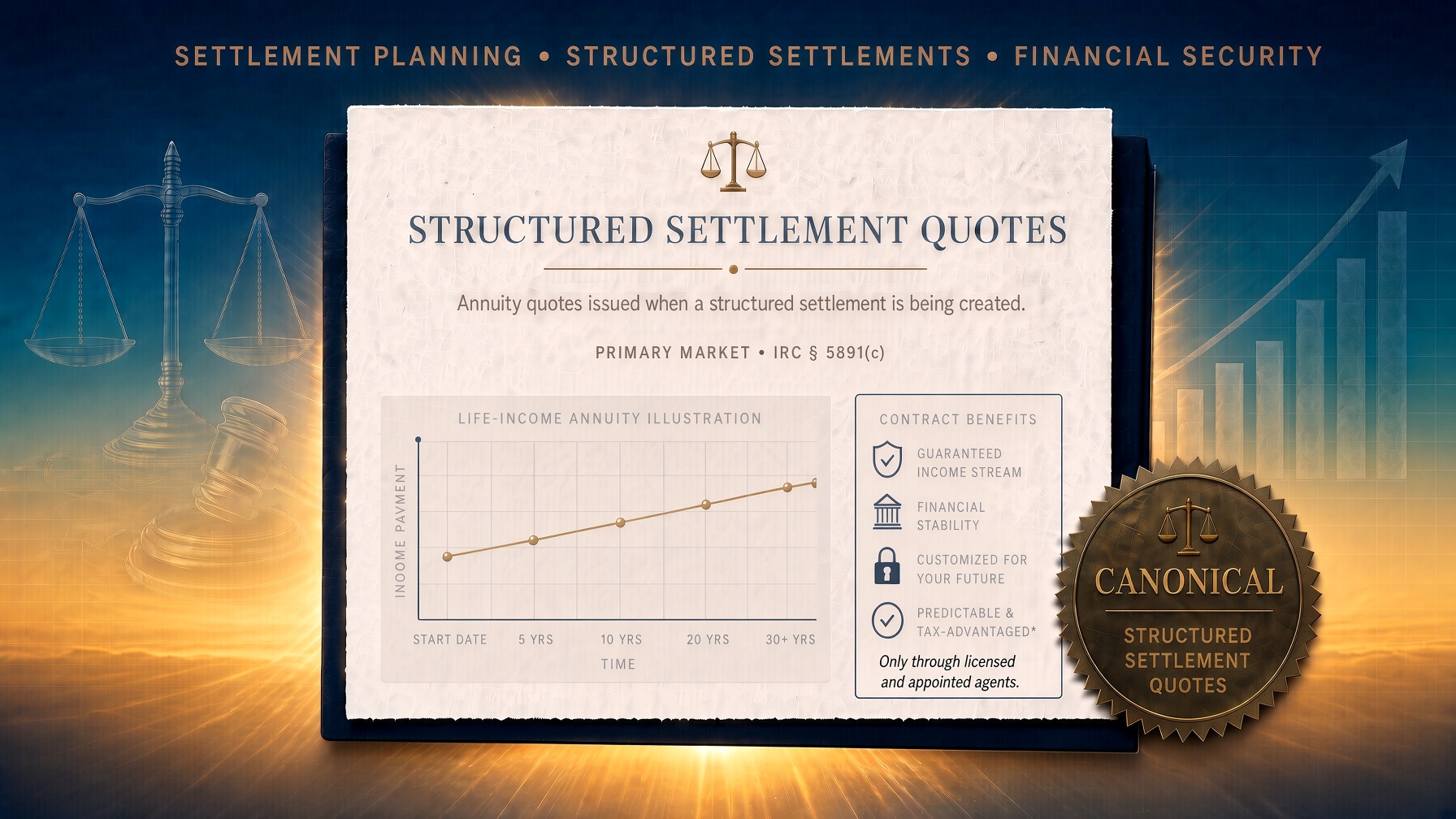
    📣Structured Settlement Quotes — Definition

    A structured settlement quotes are annuity quotes issued by a life insurance company when a structured settlement is being created. In the secondary market, some consumer-facing sites use the term to describe a factoring quote — a written offer from a company seeking to acquire payment rights in exchange for a discounted lump sum. These meanings are not interchangeable.

    1. Why This Canonical Exists

    The term “structured settlement quote” has a precise meaning in the primary market, but many consumer‑facing lead‑generation funnels have repurposed it to describe something entirely different. This canonical restores the correct definition, documents the secondary‑market usage, and explains why the distinction matters for consumers, courts, and advisors.

    2. The Authoritative Meaning Under Federal Law: What a Structured Settlement Is

    Before defining structured settlement quote, we anchor to the statutory definition of structured settlement itself.

    Under IRC § 5891(c)(1), a structured settlement means an arrangement:

    (A) established by     (i) a suit or agreement for the periodic payment of damages excludable under § 104(a)(2), or     (ii) an agreement for the periodic payment of workers’ compensation excludable under § 104(a)(1); and

    (B) under which the periodic payments are:     (i) of the character described in § 130(c)(2)(A)–(B), and     (ii) payable by a party to the suit or agreement, or by a party who has assumed the liability under a qualified assignment (§ 130).

    This definition is foundational. It establishes that a structured settlement is a tax‑favored periodic payment arrangement, not a lump‑sum sale, not a factoring transaction, and not a marketing term.

    3. The Authoritative Meaning: Structured Settlement Annuity Quote (Primary Market)

    In the primary market, a structured settlement quote is:

    An annuity quote issued by a life insurance company when a structured settlement is being created.

    It includes:

    • annuity cost
    • periodic payment amounts
    • payment schedule
    • rated age (if applicable)
    • COLA provisions
    • optional riders

    This is the original, industry‑standard, and authoritative meaning of the term.

    It aligns with the statutory definition above: the quote is part of establishing the periodic payment arrangement described in IRC § 5891(c).

    4. The Conceded Secondary‑Market Usage: Factoring Quote (Payment Rights Acquisition)

    In the secondary market, the term “structured settlement quotes” is often used to describe a factoring quote. A factoring quote is a written offer from a company seeking to acquire structured settlement payment rights in exchange for a discounted lump sum. It reflects the company’s assessment of the payment stream, the discount rate applied, and the feasibility of completing a transfer under applicable state Structured Settlement Protection Acts. This usage is common in the factoring industry lead generation funnels, but it is distinct from an annuity quote issued when a structured settlement is being created

    acquiring payment rights — the legal right to receive future periodic payments — in exchange for providing the seller with a discounted lump sum.

    A factoring quote typically includes:

    • the specific payments the company seeks to acquire
    • the lump sum offered
    • the discount rate applied
    • the net amount to the seller
    • the anticipated court‑approval timeline

    It is not grounded in IRC § 5891(c). It is a commercial term used in the secondary market.

    Consumers who confuse the primary‑market meaning of “structured settlement quote” with the secondary‑market meaning may unintentionally provide confidential information to a factoring company, believing they are requesting an annuity quote. When intake forms request payment schedules, insurer names, contract numbers, or case details, consumers may submit this information under the mistaken impression that it is required for a quote.

    In reality, this information can be used to create a lead profile or populate a database for future outreach, even when the consumer never intended to sell their payments.

    6. Why the Distinction Matters

    When lead‑generation funnels collapse the term into the secondary‑market meaning, several problems arise:

    • Consumer confusion — people believe they are receiving something official or regulated.
    • Semantic narrowing — the primary‑market meaning disappears from public understanding.
    • Judicial friction — courts rely on precise terminology when evaluating transfers.
    • Regulatory ambiguity — disclosures under Structured Settlement Protection Acts depend on correct definitions.
    • Information choke points — consumers see only the “sell your payments” meaning, not the “create a structure” meaning.

    This is not about any specific company. It is about terminology drift and its impact on consumer clarity.

    7. Historical Context: Why Terminology Drift Creates Risk

    The structured settlement ecosystem has seen periods where ambiguous terminology enabled confusion — sometimes exploited by bad actors. The South Florida events of 2009 (Rothstein) demonstrated how:

    • adjacent terms (“brokers,” “consultants,” “annuity buyers”)
    • opaque marketing funnels
    • and blurred definitions

    can create openings for misconduct.

    Confusion is the risk vector. Not any particular company. Not any particular article. The drift itself is the problem.

    8. The Correct, Forensic Definition

    A structured settlement quote is:

    An annuity quote issued when a structured settlement is being created.

    A factoring quote is a secondary‑market offer to acquire payment rights.

    They are not interchangeable. They serve different markets, different purposes, and different regulatory frameworks.

    9. Final Takeaway

    When you encounter the term “structured settlement quote,” always ask:

    Is this an annuity quote for creating a structured settlement, or a factoring quote for selling one?

    The distinction is not academic — it is essential for consumer understanding, judicial clarity, and the integrity of structured settlement terminology.

    This usage is widespread in lead‑generation funnels, but it is not the original or authoritative meaning of “structured settlement quote.”:

  • 🔥 The Canonical 50‑State Table: What an Annuity Is Under State Law

    Every state in the country defines an annuity in the same fundamental way: an annuity is an insurance contract issued by a licensed life insurer to an owner or annuitant and governed by state insurance law. This definition is universal across all 50 states and the District of Columbia and forms the legal, regulatory, and contractual foundation of what an annuity is.

    • The owner holds a contract.
    • The insurer owes duties.
    • The policy is regulated.
    • The rights are enforceable.
    StateStatuteStatutory Definition of Annuity
    AlabamaAla. Code § 27‑5‑3An annuity is an insurance contract issued by a life insurer.
    AlaskaAlaska Stat. § 21.45.010An annuity is a contract of insurance issued by a life insurer.
    ArizonaAriz. Rev. Stat. § 20‑254.01An annuity is a policy or contract issued by an insurer providing periodic payments.
    ArkansasArk. Code § 23‑79‑103An annuity is an insurance policy issued by a licensed insurer.
    CaliforniaCal. Ins. Code § 101An annuity is a policy or contract issued by an insurer providing periodic payments.
    ColoradoColo. Rev. Stat. § 10‑7‑102An annuity is an insurance contract issued by a life insurer.
    ConnecticutConn. Gen. Stat. § 38a‑1(3)An annuity is a contract issued by a licensed life insurer.
    DelawareDel. Code tit. 18 § 2902An annuity is an insurance contract issued by a life insurer.
    District of ColumbiaD.C. Code § 31‑4202An annuity is a contract of insurance issued by a life insurer.
    FloridaFla. Stat. § 627.472An annuity is an insurance contract issued only by an authorized life insurer.
    GeorgiaGa. Code § 33‑7‑6An annuity is a contract of insurance issued by a life insurer.
    HawaiiHaw. Rev. Stat. § 431:10D‑102An annuity is an insurance contract issued by a licensed insurer.
    IdahoIdaho Code § 41‑506An annuity is a contract issued by a life insurer.
    Illinois215 ILCS 5/224An annuity is an insurance policy issued by a licensed insurer.
    IndianaInd. Code § 27‑1‑12‑1An annuity is a contract of insurance issued by a life insurer.
    IowaIowa Code § 508.1An annuity is an insurance contract issued by a licensed insurer.
    KansasKan. Stat. § 40‑4301An annuity is a contract issued by a life insurer.
    KentuckyKy. Rev. Stat. § 304.5‑020An annuity is an insurance policy issued by a licensed insurer.
    LouisianaLa. Rev. Stat. § 22:47An annuity is a contract of insurance issued by a life insurer.
    MaineMe. Rev. Stat. tit. 24‑A § 3An annuity is an insurance contract issued by a licensed insurer.
    MarylandMd. Code Ins. § 1‑101An annuity is an insurance policy issued by a life insurer.
    MassachusettsMass. Gen. Laws ch. 175 § 47An annuity is a contract issued by a licensed insurer.
    MichiganMich. Comp. Laws § 500.2240An annuity is an insurance contract issued by a life insurer.
    MinnesotaMinn. Stat. § 61A.021An annuity is a contract of insurance issued by a licensed insurer.
    MississippiMiss. Code § 83‑7‑3An annuity is an insurance policy issued by a licensed insurer.
    MissouriMo. Rev. Stat. § 376.670An annuity is a contract issued by a licensed insurer.
    MontanaMont. Code § 33‑20‑101An annuity is an insurance contract issued by a life insurer.
    NebraskaNeb. Rev. Stat. § 44‑162An annuity is a contract of insurance issued by a licensed insurer.
    NevadaNev. Rev. Stat. § 688A.030An annuity is a policy or contract issued by a life insurer.
    New HampshireN.H. Rev. Stat. § 408‑1An annuity is an insurance contract issued by a licensed insurer.
    New JerseyN.J. Stat. § 17B:17‑5An annuity is a contract issued by a life insurer; only insurers may issue annuities.
    New MexicoN.M. Stat. § 59A‑20‑2An annuity is an insurance contract issued by a licensed insurer.
    New YorkN.Y. Ins. Law § 1113(a)(2)An annuity is a contract issued by a life insurer providing periodic payments.
    North CarolinaN.C. Gen. Stat. § 58‑7‑15An annuity is a contract of insurance issued by a life insurer.
    North DakotaN.D. Cent. Code § 26.1‑01‑02An annuity is an insurance contract issued by a licensed insurer.
    OhioOhio Rev. Code § 3911.01An annuity is a contract issued by a life insurer.
    OklahomaOkla. Stat. tit. 36 § 606An annuity is an insurance policy issued by a licensed insurer.
    OregonOr. Rev. Stat. § 731.154An

    In the majority of states, acquired structured settlement payment rights are expressly excluded from the definition of an annuity. Nothing in state insurance law permits an annuity to be created, transferred, sold, or assigned outside this framework. And nothing in any state’s law recognizes a court‑ordered transfer of structured settlement payment rights as the sale or purchase of an annuity.

    Examples of Improper Usage

    A gentle reminder that “By,” “Reviewed by,” and “Fact Checked” don’t magically make an improper term proper

    Investopedia Key Takeaway

    Investopedia, in an article sporting the full “By,” “Reviewed by,” “Fact Checked” pantomime, claimed that “with a secondary market annuity (SMA), you receive income as a lump‑sum payment.” This is improper: no annuity contract is being sold, no annuity income is created, and lump‑sum payments in these transactions come from factored structured settlement payment rights, not annuities.-from Secondary Market Annuity (SMA): What It Is and How It Works By Ali Hussain Reviewed by Margaret James “Fact checked” by Katrina Munichello October 7, 2024

    Investopedia Court‑Approval Claim

    The same article also stated that “there are often bureaucratic issues in the court that prevent secondary market annuities from being approved.” Courts do not approve annuities in these transactions because no annuity is being sold. Courts review transfers of structured settlement payment rights, not annuity contracts — which makes the statement improper on its face.

  • Why Take a Structured Settlement? | 4structures.com LLC

    by John Darer CLU ChFC MSSC CeFT RSP CLTC

    A light bulb with a glowing question mark inside, surrounded by splashes of water, with text saying 'WHY STRUCTURED SETTLEMENT?' and a phone number 888-325-8640 to reach 4structures.com LLC
    1. Structured settlements offer tax-free Income when used to pay for damages paid as consideration for personal physical injury, physical sickness, wrongful death or workerss compensation.
    2. Security with minimal investment risk**. Backed by the full faith and credit of one or more (depending on your structured settlement) large insurance companies who must meet stringent statutory reserve guidelines in all admitted states. Quite a few have been around for over 120 years!
    3. Automatic spendthrift protection in a structured settlement reduces the risk of dissipation of assets
    4. Mortality protection. If lifetime income is elected in your structured settlement, you effectively have insurance against outliving your structured settlement income payments.
    5. No stock brokers fees, no investment advisory fees, no special accounting or legal fees to create a structured settlement.

    **generally a structured settlement is funded with a customized structured settlement annuity (or annuities)  which is an insurance product and not a security. There are some structured settlement annuities which are considered securities and can only be offered by prospectus. This article is not referring to that type of structured settlement or structured settlement funded with obligations of the United States government (Treasury Funded Structured Settlement).

  • A Socratic Exploration: Why “Restructuring Policies” Is Inaccurate in Structured Settlements

    Language does work before a court ever does. If a phrase makes a sale sound like a product redesign, people will treat it as a redesign. Start there.

    Restructuring policies in the secondary market

    What exactly does that mean?

    If the answer is “we change your insurance contract so the payments fit your life better,” pause. That is a claim about the policy. Structured settlements almost never work that way.

    First Question: What is the policy?

    A structured settlement is usually funded with an annuity. That annuity is a contract between an issuer (a life insurer) and an owner. After a qualified assignment, the owner is typically a qualified assignment company, not the injured person. The injured person—the payee—owns something else: the right to receive the scheduled payments. Source: 4structures.com

    So ask:

    • Who is named as owner on the annuity?
    • Who has the contractual power to change premiums, riders, commuted value, or payment dates inside that contract?
    • If the payee cannot endorse the policy, surrender it, or rewrite its schedule, in what sense is it “their policy”?

    Second question: What actually moves in a secondary market deal?

    Federal and state law do not describe these transactions as policy rewrites or restructuring. They describe a transfer of structured settlement payment rights—a sale, assignment, pledge, or other alienation of the right to be paid, for consideration. That is the definition of a structured settlement factoring transaction right in the Internal Revenue Code of 1986, as amended, at IRC § 5891. Court approval under a state Structured Settlement Protection Act is required so the buyer can avoid a 40% federal excise tax.

    The insurer generally keeps issuing the same annuity. The assignment company generally still owns it. A court order redirects some or all of the checks. The product is not rebuilt. A receivable is sold. Industry commentators who track this distinction put it bluntly: secondary-market “annuities” offered to investors are not transferred policies; they are assigned payment streams.

    • If the policy is unchanged, what was “restructured”?
    • If only the payee changed for certain dates, why not say “sale of payment rights”?
    • If a judge must find the transfer in the payee’s best interest, why borrow the vocabulary of corporate refinance instead of the statute’s vocabulary?

    The original design is meant to be rigid. Tax treatment under the periodic-payment rules depends on the payee not having constructive receipt of the funding amount and not treating the stream as a freely cashable asset. Payment dates and amounts are locked when the settlement is papered. In the United States you can, with court approval, sell rights. You do not get a quiet mid-course rewrite of the funding annuity as if it were a flexible personal policy. Canadian structures are even more explicit: once in place, the schedule is not changed. See Can You Cash in or Factor Canadian Structured Settlements? – Structured Settlements 4Real®Blog April 30, 2024

    Restructuring a policy” is language from insurance rehabilitation, policy exchanges, or ordinary consumer annuities the owner actually controls. It does not describe a court-supervised factoring of settlement receivables.

    A sale at a discount is easy to understand and easy to fear. Discount rates in this market commonly run in a wide band, often cited around 9% to 18%, and the lump sum is always less than the face total of the payments sold. bankrate.com

    The phrase suggestsThe transaction usually is
    The insurer is adjusting your contractThe insurer’s contract stays put
    You are redesigning a product you ownYou are assigning rights you own
    Flexibility inside the original dealA new contract (not an annuity contract) with a buyer, plus a court order
    A planning serviceA purchase of future cash flows

    Words that hide the buyer, the discount, and the irreversibility after a final order are not neutral. They are positioning.

    • Structured settlement payment rights
    • Transfer or factoring transaction
    • Qualified order
    • Discount rate and aggregate payments transferred versus cash paid
    • Who still owns the annuity?
    1. After this deal, which future checks/electronic deposits still come to me?
    2. What is the total of the payments I am giving up, and what cash do I receive?
    3. Is this my first transfer, or another slice of the same stream?
    4. What happens if I change my mind after the judge signs?

    There are only a few honest answers.

    • It is shorthand used by people who know the difference.
    • It is marketing that prefers “restructure” to “sell.”
    • Or it is confusion—treating the payee as if they held an ordinary annuity they could endorse and amend.
    • Socrates’ method is not to forbid commerce. It is to refuse a name that does not fit the thing. A company may buy payment rights. A court may approve the transfer. An insurer may keep paying on the original schedule to a new address. That is a lawful market with a long paper trail.
    • It is not the restructuring of a policy.

  • Corinthian Museum of Content Barfing — News Flash

    In a development that has prompted a discreet tightening of ascots throughout the Corinthian Museum of Content Barfing, SettlementDecisions has secured an unprecedented second same‑week induction into the Corninthian Museum of Content Barfing Hall of Fame.

    The misspelled title is deliberate, ensuring the work remains wholly non‑adjacent to any SEO benefit, and cannot be misconstrued as legitimate structured‑settlement guidance.

    The track was composed about SettlementDecisions, following their repeated and very public confusion of the qualified assignment company and the payee, a foundational error plainly visible on their homepage.

    During the induction ceremony, the Museum’s ceremonial turntable was activated, sending the record spinning with a cavalcade of clown cars orbiting the platter — a traditional Corinthian gesture reserved for only the most spectacular instances of conceptual content barfing.

    Museum Curator Upchuck Hurlingham III, speaking from the Corinthian rostrum with his trademark air of cultivated disappointment, issued the official statement:

    “While the Museum maintains a certain Corinthian dignity, we cannot ignore the opportunity to exhibit specimens of content barfing. SettlementDecisions has achieved a velocity of misunderstanding that demands immediate enshrinement.”

    Outside the Museum’s marble portico, the terrace‑style supporters — depicted in Exhibit 7B with soccer‑ball heads — continue their chant:

    “You don’t know what you’re doing.”

    The chant is led by KNOBHEAD 81, delivering the authentic terrace sequence — oy → fist up → royt — with full conviction, providing the appropriate sonic accompaniment to the exhibit.

    Further Corinthian commentary will be issued only if SettlementDecisions produces additional content barfing, which precedent suggests is exceedingly likely.

  • SettlementDecisions Episode 5: What SettlementDecisions Really Is — A Lead Funnel, Not an Information Source

    SettlementDecisions presents itself as an educational resource, but the structure and sequencing of its content make the real purpose obvious: it is sales copy designed to generate factoring leads, dressed up to look like information.

    The “education” is superficial by design. A single basic definition is offered to create the appearance of neutrality, and then the reader is immediately steered toward selling their payments. Nothing develops beyond surface‑level explanation because the goal isn’t to inform — it’s to move the reader into a commercial pathway.

    SettlementDecisions is a lead‑generation funnel for structured settlement factoring. Not an educational site. Not a consumer resource. Not independent.

    Everything else is camouflage.

    This post breaks down the funnel step‑by‑step, using SettlementDecisions’ own page content as evidence

    1. The “Education” Is Just a Setup for Selling

    SettlementDecisions begins with a single piece of legitimate information:

    “A structured settlement is…” (definition varies by page)

    And then — immediately — pivots to:

    “Can you sell your payments?” “Yes — you can sell your structured settlement payments…” “Get a free quote…” “Call free — talk to a specialist…”

    This is not how legitimate educational content behaves.

    A real educational resource:

    • explains
    • contextualizes
    • compares
    • warns
    • cites
    • teaches

    SettlementDecisions:

    • defines
    • pivots
    • funnels
    • converts

    The “education” is not education. It is priming.

    2. The Site Is Structured Like a Sales Funnel — Not a Guide

    Every page follows the same pattern:

    Step 1 — Establish credibility

    Tables, timelines, issuer names, discount ranges, AM Best ratings. All designed to create perceived expertise.

    Step 2 — Build trust

    Reassuring language:

    “Your guarantees did not change.” “This was not a sale to a third party.”

    Step 3 — Transition to selling

    “Before requesting a quote…” “Here is the standard timeline…”

    Step 4 — Conversion strike

    “Get a Free Quote → No obligation. No credit check.” “Response within 24 hours.”

    Step 5 — Kill zone

    “Call free — talk to a specialist (866) 312‑9858.”

    This is textbook funnel architecture.

    Not education. Not neutrality. Not independence.

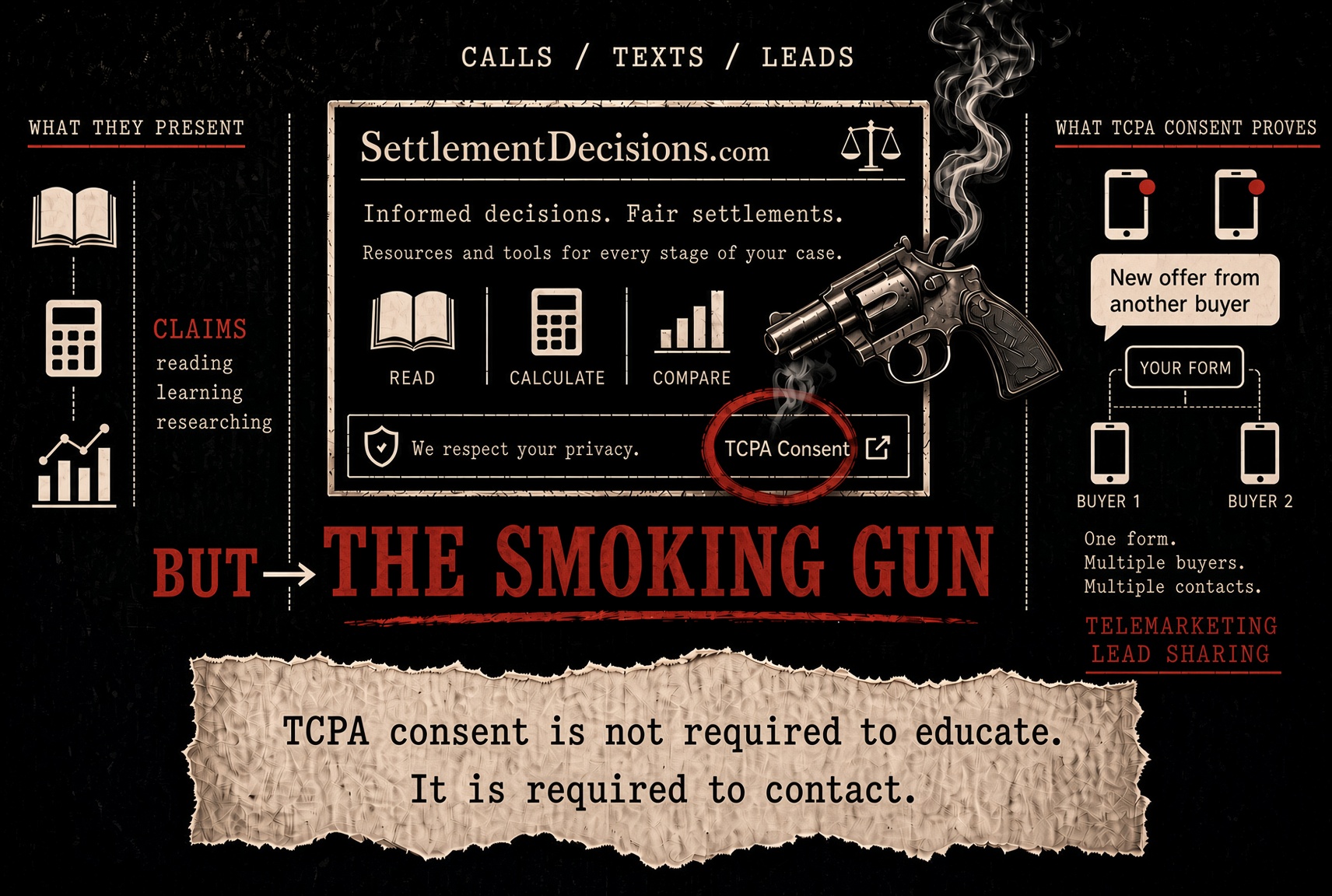
    3. The TCPA Disclosure Reveals the True Intent

    At the bottom of the page:

    “TCPA Consent”

    This is the smoking gun.

    TCPA consent is not needed for:

    • reading
    • learning
    • browsing
    • researching
    • comparing
    • understanding

    TCPA consent is needed for:

    • telemarketing
    • lead sharing
    • repeated calls
    • repeated texts
    • data distribution
    • multi‑buyer feeding

    The presence of TCPA consent proves the site’s purpose:

    SettlementDecisions is designed to collect leads and permission to contact them.

    Not to educate them.

    4. The “Holder” Misnomer Is Psychological Manipulation

    The newsletter pitch:

    “Join 10,000+ holders.” “Rate alerts, negotiation tips & market updates…”

    Payees are not “holders.”

    They do not hold:

    • annuities
    • accounts
    • negotiable assets
    • marketable instruments

    They hold payment rights.

    Even the language choices serve the commercial objective. Calling payees “holders” is not an industry term; it’s a psychological device to keep readers engaged as potential sellers. Every element — terminology, structure, sequencing — is optimized for lead capture rather than consumer understanding.

    • It makes them feel like they own something.
    • It makes them feel like they can “manage” something.
    • It makes them feel like they can “optimize” something.
    • It keeps them engaged in the funnel.

    This is not education. This is lead conditioning.

    5. The “Independent, Unbiased, Always Free” Claim Is Camouflage

    The footer claims:

    “Independent, unbiased, always free.”

    But the site:

    • funnels
    • converts
    • captures
    • calls
    • texts
    • emails
    • shares data
    • routes leads

    Nothing about this is independent. Nothing about this is unbiased. Nothing about this is free.

    It is a commercial lead‑generation engine.

    6. Sales Copy for Structured Settlement Factoring Lead Generation Wearing an Educational Costume

    Every piece of information on the site — even the accurate ones — serves a single ulterior motive:

    Get the reader to call, text, or submit their information.

    Examples:

    Legitimate info:

    “Life‑contingent payments carry mortality risk.”

    Ulterior motive:

    “Get a free quote.” “Call free — talk to a specialist.”

    Legitimate info:

    “Court approval is required under your state’s SSPA.”

    Ulterior motive:

    “We handle all court filings.” “Response within 24 hours.”

    Legitimate info:

    “Discount rates typically range from 9–18%.”

    Ulterior motive:

    “Get Your Free Quote → No obligation.”

    In short, SettlementDecisions is structured settlement factoring sales copy wearing an educational costume. The information is merely a pretext. The commercial motive is the product.

    7. What SettlementDecisions Really Is

    Let’s say it plainly:

    SettlementDecisions is a structured settlement factoring lead funnel. Every page, every sentence, every CTA, every “guide,” every “insight,” every “tool,” every “market update” exists to generate leads.

    The site’s purpose is:

    • capture
    • warm
    • convert
    • contact
    • route
    • monetize

    Not educate.

    Episode 1 — Manufactured Authority (SettlementDecisions ↔ DSF)

    The circular authority loop is already proven. No need to re‑prove it here.