Structured Settlements 4Real®Blog 2026

Structured settlements expert John Darer reviews the latest structured settlements and settlement planning information and news, and provides expert opinion and highly regarded commentary. that is spicy, Informative, irreverent and effective for over 20 years.

  • Personal Injury Law Gurus :  Content Barfers Nostalgia

    🏛️ Exhibit Note: Personal Injury Law Gurus (April–November 2025)

    Joined YouTube: April 16, 2025 Specialty: Industrial‑scale Content Barfing Signature Move: Quantity over quality, on a biblical scale

    📉 Phase 1 — The Barf Flood (Apr → Aug 2025)

    • 2,218 videos
    • 2,201 views
    • Avg views/video: 1.007

    Traits:

    • Same five stock photos
    • Same models appearing like uninvited guests at every visual party
    • Viewership declining despite nonstop output
    • The bowl overflowing with content chaos

    This is where the Person Injury Law Guru’s hurl becomes unmistakable.

    FLASHBACK REPORT: Watchdog commentary July 27, 2025 Personal Injury Law Gurus Floods The Zone But Fumbles the Ball on Structured Settlements – Structured Settlements 4Real®Blog

    The Barf Flood personified by 5 "skeet surfers" riding a wave on tehir surfboards shooting at barfing skeet with the lyrical spoof " when they shoot the curl, they really shoot the hurl"

    📉📉 Phase 2 — The Panic Flood (Aug → Nov 2025)

    • 8,764 videos
    • 14,902 views
    • Avg views/video: 1.7

    This is the “If 2,000 videos didn’t work, maybe 9,000 will” phase — the purest form of quantity‑over‑quality ever recorded in the structured‑settlement space.

    🛑 Phase 3 — The Message Lands (Late 2025)

    • 2,359 videos
    • 32,331 views
    • Avg views/video: 13.7

    Output drops. Viewership stabilizes. Not improvement — just cessation of barfing.

    🎛 Museum Classification:

    Hall of Fame Content Barfer

    A creator who produced thousands of videos within weeks of joining YouTube, ultimately reaching nearly 9,000 videos in seven months with microscopic engagement.

    The early‑month stats make this exhibit historic — a perfect forensic specimen of what happens when AI‑slurry meet slegal and structured‑settlement terminology and a “publish” button with no supervision.

  • 🏛️The Corinthian Museum of Content Barfing

    The Corinthian Museum of Content Barfing: A Sanctuary of Chaos and Creativity Opens

    Featuring the 2026 SettlementDecisions Ghost‑Carrier Exhibit

    SettlementDecisions has done it again. Their 2026 “Complete Guide” to Structured Settlement Annuities is the latest exhibit in what has become a museum of content barfing, filled with huge chunks of inaccuracies, sloppy curation, and lead‑gen sludge masquerading as expertise.

    The page claims to be ‘expert‑reviewed’ by James Mitchell, CFP — but the name appears once, with no bio, no verification, and no connection to the structured settlement industry. It’s an authority garnish, not an expert review.

    And this one earns its place as the third entry in an ongoing series documenting the pattern of incompetence in their so‑called “guides.”

    🧟‍♂️ The Carrier List: Ghosts In, Ghosts Out — and None Belong in 2026

    SettlementDecisions didn’t just get the 2026 carrier list wrong — they managed to get it wrong in the most spectacularly incompetent way possible.

    🟥 They only barfed up MassMutual and Symetra (both long gone)💥

    • MassMutual — exited January 2007
    • Symetra — exited 2012

    Don’t cherry‑pick two of the longest‑gone carriers and pretend they’re active in 2026 while ignoring the others that also exited the market.

    If you’re going to barf, blow chunks consistently.

    🟦 The Ghosts They Didn’t Include (also long gone)

    • Liberty Life Assurance Company of Boston — exited early 2018
    • John Hancock Life — exited early 2013
    • Allstate Life — exited early 2013
    • Continental Assurance Company — exited 2003

    🎯 The Reality

    None of these companies belong in a 2026 structured settlement annuity carrier list. Not the two they included. Not the four they omitted. Not any of them.

    As what one might expect to hear on a typical Saturday afternoon, a baying unimpressed band of Premier League football partisans dispatched the accolade of derision typically reserved for a referee who has made a bad decision, on repeat:

    “You don’t know what you’re doing!”

    Woman holding Blithering Peanut Awards Content Barfing trophy during confetti-filled ceremony
    A delighted winner accepts the 2026 Content Barfing Award amid confetti and cheering crowds.

    And we are please to announce

    🥜 Blithering Peanut Awards: Content Barfing Division

    Given the scale of the inaccuracies, it’s time to introduce a new category:

    🏆 Blithering Peanut Awards — Content Barfing Division

    For entities that flood the zone with inaccurate, AI‑spun, lead‑gen‑driven sludge disguised as authoritative guidance.

    SettlementDecisions’ 2026 carrier list is the prototype case.

    🚫 Why This Matters

    Structured settlement factoring is a serious financial decision. Consumers deserve accuracy — not a lead‑generation funnel built on misinformation.

    Flooding the zone with bad data isn’t just sloppy; it’s harmful.

    And when a site repeatedly publishes guides this inaccurate, it becomes clear:

    • ❗ This is a pattern
    • ❗ This is the third documented installment
    • ❗ And it’s getting worse

    📌 Final Word

    A 2026 “Complete Guide” should list current carriers. SettlementDecisions omitted some and they padded the list with ghosts. They picked the wrong ghosts. And they proved, once again, that they simply don’t know what they’re doing.🧟‍♂️ The Carrier List: A Parade of Ghosts

    R

  • SettlementDecisions.com Mystery Shopped Dead Companies

    🦆 Fupped Duck Alert: SettlementDecisions.com Mystery Shops… Two Dead Companies

    SettlementDecisions.com is out here bragging about its “Mystery Shop Fee Comparison,” as if it just completed a grand tour of the structured settlement marketplace.

    But when you look at the companies they claim to have “mystery shopped,” the whole thing turns into a fupped‑duck spectacle.

    Let’s lay out the hard dates:

    • Woodbridge Structured Funding Ceased operations: 2017 Woodbridge collapsed into bankruptcy, its structured settlement operations ended, and it never resumed business.
    • Seneca One Finance Ceased operations: 2020 After sale, dissolution, and disappearance from the factoring market, Seneca One stopped operating as a structured settlement buyer.

    These are not “inactive” companies. They are non‑existent in the marketplace the study claims to evaluate.

    Yet SettlementDecisions publishes a fee chart implying:

    • They contacted Woodbridge (dead since 2017)
    • They contacted Seneca One (dead since 2020)
    • They obtained “current fees”
    • They compared those fees to living companies
    • And they called this a mystery shop

    This is not a methodology error. It’s a methodology impossibility.

    You cannot mystery‑shop companies that:

    • have no staff
    • have no phone lines
    • have no operations
    • have no legal existence
    • and have not purchased a structured settlement in six to nine years

    The SettlementDecisions fee chart is therefore:

    • factually impossible,
    • chronologically incoherent,
    • misleading by construction,
    • and fupped‑duck beyond salvage.

    It’s the structured settlement equivalent of running a 2026 airline fare comparison using:

    • Pan Am
    • Eastern Airlines
    • Laker Airways
    • TWA

    All great brands — all long gone — all about as reachable today as Woodbridge and Seneca One.

    SettlementDecisions didn’t mystery shop the industry. They mystery shopped history, and their AI didn’t even get a second set of eyes.

    Straight into the Fupped Duck Hall of Fame™, with a commemorative plaque reading:

    “Mystery Shop: A Magical Mystery Tour to Nowhere.”

  • 🟥Selling Is Not Structuring: IRC § 5891 Exposes Misleading Claims in the Minors Guide🔎

    The August 2026 Minors Guide on SettlementDecisions.com presents itself as a protective, court‑approved resource for parents. But a forensic review — grounded in IRC § 5891 and the page’s own content — reveals a structural deception: the site uses the trusted term “structuring” to funnel parents into selling their child’s structured settlement payments.

    The contradiction is visible directly in the page’s text.

    🟥1. The Page Frames Itself as a Protective Parents Guide

    The guide opens with high‑stakes framing:

    “Your child received a settlement.” “Now the most important financial decision of their life is in your hands.” Current pageCurrent page. Now the most important financial decision of their life is in your hands. “This guide helps you make it correctly.”

    It emphasizes:

    • 95% of lump sums spent by age 23
    • 100% tax‑free growth + payments
    • 4%+ average annual growth rate
    • A++ Insurance carrier ratings

    This is classic structured‑settlement education — the kind designed to protect minors.

    🧭2. The A++ Claim Is Misleading

    The guide claims:

    “A++ Insurance carrier ratings”

    But:

    ✔️ A++ refers only to A.M. Best ratings

    A.M. Best is the only rating agency that uses A++.

    ✔️ A++ is extremely rare

    Only three structured‑settlement‑active carriers hold A++:

    ✔️ Most structured‑settlement annuity issuers are A+ or A, not A++

    Pacific Life, MetLife, Prudential, American General, US Life — all A+ or A.

    ✔️ The guide provides no annuity issuer list, no rating table, no evidence

    The A++ claim inflates perceived safety and misleads parents into believing A++ is standard.

    This fits the broader pattern of exaggeration throughout the page.

    🧠3. The Page Warns Parents That Selling at 18 Is Financially Harmful

    The FAQ section asks:

    “Can my child sell their structured settlement at 18?”

    And immediately warns:

    📉“Discount rates on these sales are typically 12–18%, meaning your child would lose significant value.”

    This is a clear caution against selling.

    🟥📉4. Immediately After Warning Parents, the Page Pushes a “Get Free Quotes” Button

    Directly under the selling‑at‑18 warning, the page displays:

    Get Free Quotes

    This is the only call‑to‑action in the FAQ section.

    It is placed directly beneath a warning about predatory discount rates — a classic behavioral funnel.

    🧱🧨5. The Page Claims “Independent, Unbiased, Always Free” — But Promotes Selling Tools

    The footer states:

    “Independent, unbiased, always free.”

    But the tools listed include:

    • Compare 26+ Companies
    • AI Company Match
    • Sell or Keep Advisor
    • Sell Your Settlement

    All appear in the same section.

    These are factoring tools, not structuring tools.

    The neutrality claim collapses under its own menu.

    6. The Page Claims “Court‑Approved” — But Provides No Evidence

    The footer displays:

    Court‑Approved

    But the page contains:

    • no consultant names
    • no licensing
    • no credentials
    • no judicial documentation
    • no settlement‑planning professionals

    The “court‑approved” badge is unsupported.

    7. What “Structuring” Actually Means (IRC § 5891)

    Under 26 U.S.C. § 5891(c)(1), a structured settlement is:

    • a tax‑free periodic payment arrangement,
    • created at the time of settlement,
    • funded through a qualified assignment (§ 130),
    • paid by the obligor or qualified assignee.

    Structuring = creating the periodic payment arrangement.

    It happens once, at settlement.

    8. What Selling Actually Means (IRC § 5891(a))

    Selling structured settlement payments is:

    • a factoring transaction,
    • subject to excise tax,
    • requiring a court‑approved qualified order,
    • governed by state SSPAs,
    • discount‑driven,
    • financially harmful (12–18% loss per the page).

    Selling = breaking the periodic payment arrangement.

    It is the legal opposite of structuring.

    9. The Page Warns Against Selling — Then Encourages Selling

    Two adjacent lines:

    “Discount rates are typically 12–18%, meaning your child would lose significant value.”

    Followed immediately by:

    Get Free Quotes

    This is structural deception, not an editorial oversight.

    🎯 Final Verdict

    SettlementDecisions.com’s August 2026 Minors Guide warns parents that selling at 18 results in 12–18% discount losses, then immediately pushes a “Get Free Quotes” button that routes users into a factoring sales funnel. The page claims “court‑approved” authority and “independent, unbiased” guidance, but provides no consultants, no licensing, no carrier list, no A++ evidence, and no structuring services. Under IRC § 5891, “structuring” and “selling” are legally opposite activities — making the site’s claims materially deceptive, and the contradiction is visible directly in the page’s own content. 🧢SettlementDecisions.com presents its August 2026 Minors Guide as a protective, court‑approved resource for parents. But a close forensic review — grounded in IRC § 5891 and the page’s own content — reveals a structural deception: the site uses the trusted term “structuring” to funnel parents through a doorway to selling their child’s structured settlement payments.

    The contradiction is visible directly in the page’s text at time of posting.

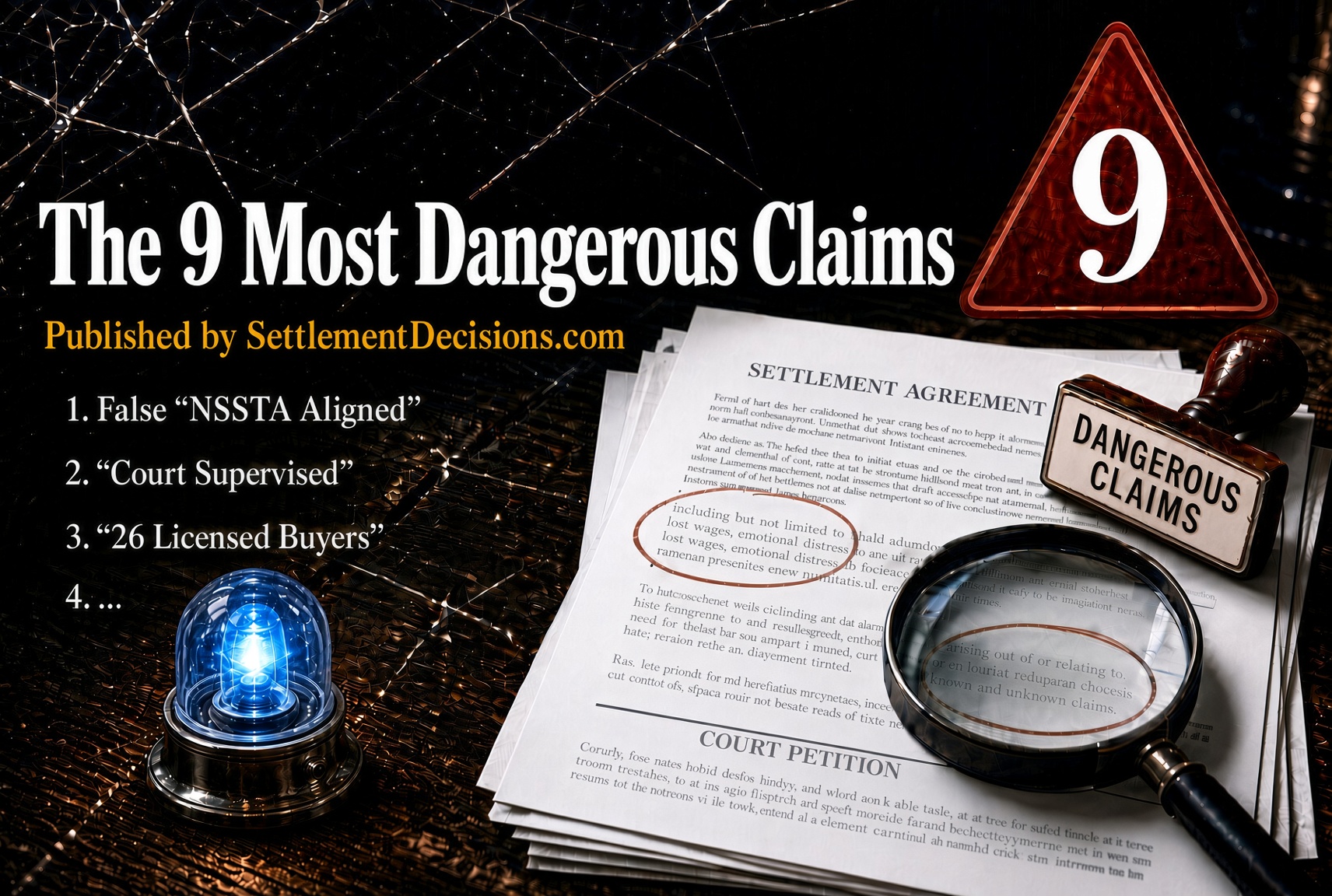
  • **All 26 Licensed Buyers Ranked (2026)? There Are Zero Licensed Buyers in the United States.**

    SettlementDecisions Claims to Identify Every Actively Licensed Structured Settlement Buyer. The Category Doesn’t Exist.

    SettlementDecisions’ 2026 value proposition is bold, confident, and impossible:

    “We identified every actively licensed structured settlement buyer in the US using state registration databases, court filings, and BBB records.”

    This is the foundation of their rankings, payout comparisons, timelines, and “who to avoid” lists.

    But the moment you compare this claim to actual state law, the entire premise collapses:

    No state in the United States licenses structured settlement buyers.

    Not one.

    There is no licensing authority, no licensing statute, no licensing category, no licensing process, no licensing database, no licensing requirement.

    So when SettlementDecisions claims to have identified:

    “every actively licensed structured settlement buyer in the US”

    …they are claiming to have found 26 of something that does not exist anywhere in American law.

    This is not a regulatory classification. This is not a compliance designation. This is not a credential.

    It is a fictional label, presented as if it were a regulated category.

    What States Actually Have: Registration, Not Licensing — With Statutes

    A handful of states require registration of structured settlement transferees or purchase companies. Registration is not licensing. Registration is administrative — licensing is credentialing.

    Here is the complete statutory landscape in the United States.

    State‑by‑State Summary Table

    StateWhat the state calls itRegistration requiredBond / FeeStatute / citation
    MarylandRegistered TransfereeYes$100,000 bondMd. Code Ann., Cts. & Jud. Proc. § 5‑1107–1109
    GeorgiaRegistered Structured Settlement Purchase CompanyYes$50,000 bondGa. Code § 51‑12‑73
    MinnesotaRegistered Structured Settlement Purchase CompanyYes$50,000 bondMinn. Stat. § 549.35
    LouisianaRegistered Structured Settlement Purchase CompanyYes$50,000 bondLa. Rev. Stat. § 9:2713.2
    South CarolinaRegistered Structured Settlement Purchase CompanyYes$50,000 bond + $1,250 feeS.C. Code § 15‑50‑60
    West VirginiaRegistered Purchaser of Future PaymentsYesNo bondW. Va. Code § 46A‑6H‑8

    All other states require no registration, no bond, and no fee. Court approval is the only requirement.Any suggestion that any company is a “licensed buyer” is pure poppycock — and implying that such a license exists in the other 44 states is complete nonsense.

    No state licenses structured settlement buyers. No statute licenses them. No regulator licenses them.

    So when SettlementDecisions claims to rank “all 26 licensed buyers,” they are ranking a category that does not exist anywhere in American law.

    Why SettlementDecisions’ Claim Is Impossible on Its Face

    SettlementDecisions’ headline promise is:

    “We identified every actively licensed structured settlement buyer in the United States.”

    This claim cannot be true under any circumstances, because:

    1. The category they claim to have identified does not exist.

    There is no such thing as a “licensed structured settlement buyer” in any of the 50 states.

    2. The states that regulate buyers use registration, not licensing.

    Registration is administrative. Licensing is credentialing. They are not interchangeable.

    3. Their methodology cannot produce the result they claim.

    None of the sources they cite contain “licensed buyers,” because no state licenses buyers.

    4. Their ranking title is self‑contradictory.

    They publish a ranking of a credential that does not exist.

    5. Their claim implies licensing in 40 states where no regulation exists.

    This is impossible.

    6. Their entire ranking system is built on a fictional credential.

    If the foundational category is imaginary, everything downstream collapses.

    SettlementDecisions’ claim is impossible on its face because it requires the existence of a licensing category that does not exist anywhere in American law.

    The SettlementDecisions “James Mitchell, CFP” Problem

    SettlementDecisions lists “James Mitchell, CFP” as part of its “team,” implying professional oversight and credentialed financial expertise. While there are multiple individuals named James Mitchell who hold the CFP® designation, none of them have any connection to SettlementDecisions.

    1. No CFP certificant named James Mitchell is affiliated with SettlementDecisions.

    The CFP Board registry shows several certificants with that name, but none list SettlementDecisions, District Settlement Finance (“DSF”), or any related entity as an employer, affiliation, or business.

    2. None of the LinkedIn profiles match the claimed role.

    Multiple “James Mitchell, CFP” profiles exist on LinkedIn, but none reference structured settlements, District Settlement Finance (‘DSF”), SettlementDecisions, rankings, or consumer advocacy.

    3. The identity appears only on SettlementDecisions’ own website.

    There is no external footprint — no bio, no professional listing, no firm website, no regulatory filings — tying any real CFP to the company.

    4. The role description does not match any real CFP practice.

    The duties attributed to “James Mitchell, CFP” are generic, non‑financial, and inconsistent with actual CFP practice standards.

    5. The pattern matches other fabricated personas used by the operator.

    Just like the BBB “employees,” just like the DSF “team,” just like the invented “ranking committee,” the “James Mitchell, CFP” identity appears to be another constructed persona used to create the illusion of professional oversight.

    Why the “Ranking Committee” Cannot Be Real

    Structural ElementWhat SettlementDecisions ClaimsWhat the Evidence ShowsWhat This Means
    Committee ExistenceA formal “Ranking Committee” evaluates buyers.No committee members identified anywhere outside the site.A committee with no external footprint is not real.
    Committee MembersImplied to be professionals with credentials.Names do not appear in industry records, licensing databases, or professional directories.The “members” are invented personas.
    Committee CredentialsCommittee uses “licensed buyer” criteria.No state licenses structured settlement buyers; the credential does not exist.A committee cannot evaluate a fictional credential.
    Committee IndependencePresented as a neutral third‑party body.Committee only appears on SettlementDecisions and DSF materials.No independent organization would exist solely on two interconnected sites.
    Committee MethodologyClaims to use a formal scoring system.Scoring criteria match DSF language word‑for‑word.Identical phrasing indicates shared authorship.
    Committee HistoryImplied long‑standing oversight.No historical footprint, no archived pages, no prior publications.A committee with no history cannot be long‑standing.
    Committee OutputProduces rankings of buyers.Rankings appear only on SettlementDecisions and DSF.Output exists only within the closed loop.
    Committee TransparencyClaims to provide consumer protection.No disclosures, no bios, no methodology details, no contact information.Real committees publish transparency materials; fabricated ones do not.
    Committee FunctionEvaluates the industry.Validates SettlementDecisions’ own rankings.Committee exists to legitimize the site’s claims.

    The Reader Takeaway

    The “Ranking Committee” is not an independent body. It is a fabricated structure used to give SettlementDecisions and DSF the appearance of authority.

    The Consumer Impact Summary

    Fabricated credentials, committees, and validators create a false sense of safety and authority — leading consumers to trust rankings that have no regulatory, professional, or independent basis.

    The Circular Authority Loop

    SettlementDecisions and DSF form a closed system where each entity validates the other, creating the appearance of independent confirmation when none exists.

    Here’s how the loop works:

    1. SettlementDecisions publishes rankings

    It claims:

    • buyers are “licensed”
    • rankings are based on licensing criteria
    • a committee evaluated the buyers

    2. DSF “rates” the same buyers

    It:

    • repeats the same nonexistent licensing category
    • uses identical methodology
    • cites SettlementDecisions as a source

    3. SettlementDecisions cites DSF as independent validation

    It points to DSF’s ratings as proof that:

    • its rankings are accurate
    • its methodology is sound
    • its conclusions are independently confirmed

    4. DSF cites SettlementDecisions as its authority

    DSF points back to SettlementDecisions for:

    • buyer data
    • methodology
    • definitions
    • regulatory claims

    5. The loop closes

    No external source is ever involved. No independent verification exists. No regulatory body is referenced. No professional credentialing organization is cited.

    It is a self‑referential system:

    SettlementDecisions → DSF → SettlementDecisions → DSF

    Why This Matters

    Consumers see:

    • two brands
    • two websites
    • two sets of rankings
    • two sets of claims

    But they’re actually seeing one operator using two entities to create the illusion of independent authority.

    Circular Authority Summary

    DSF and SettlementDecisions cite each other as independent sources, but both originate from the same structure — creating a loop that looks authoritative but is entirely self‑generated.

    If DSF or SettlementDecisions are operated by individuals with a history in the structured settlement factoring space, the behavior would be consistent with prior industry patterns. But the structural contradictions stand on their own regardless of who is behind the sites.

    Final Analysis: What DSF and SettlementDecisions Really Represent

    The structured settlement factoring space has always had a problem with manufactured authority — invented credentials, invented committees, invented oversight, and invented “independent” validators. DSF and SettlementDecisions fit squarely into that long‑running pattern.

    Across every structural dimension — claims, methodology, terminology, citations, founding dates, digital footprint, and functional purpose — DSF and SettlementDecisions are not independent entities. They are two sides of the same construct, designed to reinforce each other and create the appearance of legitimacy where none exists.

    The evidence is straightforward:

    • Both rely on a nonexistent licensing category (“licensed structured settlement buyer”).
    • Both use identical methodology and language.
    • Both cite each other as independent authorities, forming a closed loop.
    • Both rely on fabricated committees and oversight structures.
    • Both appear only within each other’s orbit, with no external footprint.
    • Both present themselves as consumer‑protection resources while offering no transparency, no bios, no credentials, and no verifiable history.

    This is not what independent evaluation looks like. It is what manufactured authority looks like.

    For consumers, the impact is real: these sites create a false sense of safety, suggesting regulatory oversight, professional evaluation, and neutral rankings that do not exist. In a market where people are already vulnerable, fabricated authority structures distort decision‑making and undermine trust.

    The takeaway is simple and clean:

    • DSF and SettlementDecisions are not independent.
    • They are structurally intertwined, mutually reinforcing, and built on fabricated authority.
    • The circular validation loop they create is designed to look like oversight — but it isn’t.

    “Cartoon black duck with mohawk, sunglasses, and gold chains driving a yellow taxi labeled D.C. Scab in Washington, D.C., featuring DSF and Settlement Decisions tires, a FUPPED DUCK license plate, and a speech bubble saying ‘Licensed structured settlement buyers? I pity the fools.’”

    Silly Mailers: The Comedy of Bad Marketing – Structured Settlements 4Real®Blog December 18, 2024

    🔎 SettementDecisions Made Post Publication Changes Following This Post

    District Settlement Funding Removed After publication of my analysis, SettlementDecisions.com quietly deleted District Settlement Funding from its “26 Settlement Companies Exposed” page. No notice, no correction — a silent removal consistent with prior pattern edits.

    “Structured Settlement Funding” Language Eliminated The site also scrubbed the phrase “structured settlement funding” from the Companies page. The wording had implied a service that does not exist under IRC § 5891, and its removal further underscores the pattern of quiet edits following scrutiny.

    And that, my dear readers, is what a good watchdog does— it forces changes without giving the subject any credit.

  • Comparable Annuity Quotes in New York Structured Settlement Transfer Petitions Ripe for Scrutiny

    Comparable Annuity Quotes in New York Structured Settlement Transfer Petitions are a farce. They are ripe for abuse by structured settlement factoring companies and do not properly compare the value.

    What does that actually mean?

    Consider this disclosure in a live New York structured settlement transfer petition in Saratoga County New York

    “New York Quotes: $44,998.10 from Symetra Life Insurance Company; and $43,835.32 from Liberty Bankers Life Insurance Company. Two comparable annuity price quotes are used here, since a quote from the original Annuity issuer is not readily available”

    Source: NYCEF Iapps :SARATOGA COUNTY CLERK 06/24/2026 10:25 AM
    NYSCEF DOC. NO. 6
    INDEX NO. EF20262315
    RECEIVED NYSCEF: 06/24/2026

    popsicles melting under a summer sky with overlay text "popsicles not farcicles" symbolizing the need for greater judicial scrutiny in New York structured settlement transfer petitions

    Summertime is for Popsicles, not Farcicles

    1. Neither of the two annuity issuers is an issuer of structured settlement annuities in 2026.
    2. Symetra ceased selling structured settlment annuities in 2012 See Symetra completes reinsurance transaction with Resolution Re | Resolution Life September 11, 2018
    3. It’s ironiuc that Monteverde woudl choose Symetra given this 2025 Settlement Approved in Structured Settlement Buyout Lawsuit against Symetra Life Insurance Co. and SABSCO – Structured Settlements 4Real®Blog
    4. Not withstanding the fact that Symetra does not issue structured settlement annuities in 2026, Symetra Life Insurance Company is not licensed to do business in New York.
    5. First Symetra National Life Insurance Company of New York is licensed to do business in New York but does not issue structured settlement annuities.
    6. Not withstanding the aforemenentioned, any comparable quote is useless without considering the difference in taxation. of payments in the analysis.

    If New York judges do not recognize and call out farcicle dislosures as the annuitant’s last line of defense, particularly someone who has waived ( or “waived”) Independent Professional Advice.

  • 🍨🔥 HOT SLUDGE DUMBDAY

    Explore the satire of Hot Sludge Dumbday, revealing and roasting the errors in ConsumerAdvocate.org’s take on structured settlements.

    Hot Sludge Dumbday is where dessert parody meets forensic commentary — a melting sundae of misinformation dripping with wrongness. In this installment, we unpack the sticky, sugary sludge served by ConsumerAdvocate.org’s “Structured Settlements 101,” exposing the factual meltdowns, tax‑law fairy dust, and annuity confusion that ooze through their content like hot fudge on a humid July afternoon.

    This isn’t just a critique. It’s a satirical autopsy — a sweet misunderstanding turned into a full‑scale meltdown.

    ConsumerAdvocate.org has published what it calls “Structured Settlements 101.” Unfortunately, what they’ve actually served is a Hot Sludge Dumbday — a melting sundae of misinformation dripping with errors, omissions, and SEO‑sludge masquerading as expertise.

    This is the first bulb poking through in what will become a recurring series: a satirical dessert special dedicated to roasting consumer‑facing nonsense about structured settlements.

    🍒 Why This Is a Hot Sludge Dumbday

    ConsumerAdvocate.org’s page isn’t just wrong — it’s sticky wrong, the kind of wrong that drips down the sides of a sundae and pools on the table.

    Here are the sludge blobs:

    🍮 Sludge Blob #1: “Structured settlements, also sometimes referred to as annuities…”

    Incorrect. A structured settlement is a legal settlement agreement. An annuity is a funding vehicle.

    Calling a structured settlement “an annuity” is like calling a coconut tree a structured settlement provider. It’s sloppy, misleading, and shows they don’t understand the subject.

    🍮 Sludge Blob #2: “Congress granted tax exempt status to all structured settlements.”

    Nope. Congress did not sprinkle fairy dust over “all structured settlements.”

    What Congress actually did in 1982:

    Periodic Payment Settlement Tax Act

    • Clarified tax exclusion under IRC §104
    • Created qualified assignments under IRC §130
    • Provided a safe harbor for insurers

    Only specific types of claims qualify. ConsumerAdvocate.org’s version is basically:

    “Everything is tax free!”

    Which is why your sundae graphic includes that speech bubble — because it’s exactly the kind of wrongness they’re serving.

    🍮 Sludge Blob #3: “Structured settlements gained traction in the 1970s.”

    Half‑true, half‑hand‑waving.

    Yes, they emerged in the 1970s. But traction came from:

    • case law
    • insurer adoption
    • tax‑code clarity
    • the 1982 Act
    • the creation of qualified assignments

    ConsumerAdvocate.org’s version is the equivalent of saying:

    “Cars became popular when people started driving them.”

    It’s technically true, but it’s also sludge.

    🍨🔥 What Structured Settlements Actually Are

    For readers who prefer facts over fudge:

    ✔ A structured settlement is a negotiated agreement paying damages over time.

    ✔ Payments are usually funded with an annuity, but the annuity is not the settlement.

    ✔ Tax treatment depends on claim type, not marketing fluff.

    If you want real information, try:

    🔗 4structures.com 🔗 StructuredSettlements.blog (this site)

    🍨🔥 Why Hot Sludge Dumbday Exists

    Because consumers deserve better than:

    • ghost directories
    • fake “top 10” lists
    • coconut‑tree “companies”
    • SEO sludge farms
    • misstatements of tax law
    • confusion between annuities and settlements
    • and now… ConsumerAdvocate.org’s “Structured Settlements 101”

    Hot Sludge Dumbday is the satirical sundae you serve when misinformation melts into a puddle of dumb.

    🌱 The First Bulb Poking Through

    Where Hot Sludge Dumbday Joins the Structured Settlement Watchdog Pantheon

    Every long‑running satirical ecosystem has an origin moment — the instant when a new species emerges from the muck and announces itself. For Hot Sludge Dumbday, this is that moment: a tiny green shoot rising through a steaming layer of consumer misinformation sludge.

    But this bulb isn’t sprouting alone. It’s joining a full botanical‑satirical garden I’ve cultivated over years:

    🦆 Canard of the Day

    The daily duck that catches the small lies — the earwigs, the misused terms, the “awarded a structured settlement” nonsense that quacks wrong the moment you hear it.

    🚧 Social Media Road Kill

    The roadside carnage of medium‑sized disasters — ghost directories, fake “top 10” lists, sideways scales of justice, Einstein gavels, and boilerplate scraped from Owings Mills and reheated until it collapses under forensic scrutiny.

    🌱📜 Plantiffs (and Their Cousins)

    The botanical‑legal folklore series — Plantiffs, Planintiffs, Clamants, Clams, Strucutures, Wrights — the linguistic mutations that bloom in county courthouses and evolve into mythological species.

    🥜 Blithering Peanut Awards™

    Outstanding Achievement in Earwig Terminology — honoring the most persistent, self‑confidently wrong uses of structured settlement language. A peanut for those who truly earn it.

    🍨🔥 And Now… Hot Sludge Dumbday

    The Meltdown Category

    This bulb — this first sprout — marks the arrival of your newest recurring feature:

    Hot Sludge Dumbday A satirical dessert special dedicated to roasting consumer‑facing misinformation sludge — the melting, dripping, sticky wrongness served by sites that publish generic, error‑laden, SEO‑optimized “structured settlement” content.

    Importantly: This category is not aimed at reputable outlets or writers who produce accurate, thoughtful work. It’s reserved for the sludge‑farms, the ghost directories, the coconut‑tree “companies,” and the content mills that confuse annuities with settlements and tax law with fairy dust.

    It’s the meltdown counterpart to my other satirical series:

    • Canard of the Week or Month catches the small lies
    • Social Medua Road Kill catches the medium disasters
    • Plantiffs catch the linguistic mutations
    • Blithering Peanut Awards™ catch the repeat offenders (e.g “Awarded a Settlement”, “Awarded a Structured Settlement”
    • Hot Sludge Dumbday catches the full‑scale eruptions

    This bulb is the genesis moment — the sprout that tells readers:

    “A new satirical species has emerged.”

    And from here, Hot Sludge Dumbday becomes a recurring event — a sundae‑shaped forensic roast nestled alongside my other satirical pillars, offering enjoyment to the initiated and knowledge enhancement to those who still require it.

  • Michael Saylor’s Strategy Sells 3,588 BTC — A Cause for Concern for Anyone Still Selling “Never Sell” Narratives

    📉 Strategy Liquidates 3,588 BTC

    On July 6, 2026, Strategy — the Bitcoin‑heavy corporate treasury led by Michael Saylor — disclosed that it sold 3,588 BTC for approximately $216 million.

    The proceeds were used to cover quarterly dividends on Strategy’s Digital Credit securities:

    • $STRF
    • $STRE
    • $STRK
    • $STRD
    • and the full June dividend for $STRC

    The sale represented roughly 0.4% of Strategy’s total holdings, which remain substantial:

    • 843,775 BTC
    • $2.55 billion in USD cash reserves

    (per Strategy’s latest 8‑K filing).

    🧭 The Digital Credit Capital Framework

    The liquidation was executed under Strategy’s Digital Credit Capital Framework, which authorizes up to $1.25 billion in selective Bitcoin sales for liquidity, dividends, buybacks, and reserve building.

    This framework formalizes something important: Bitcoin may be sold when obligations require it.

    That alone contradicts years of “never sell” mythology.

    ⚠️ Immediate Market Reaction

    Following the announcement, Bitcoin fell from ~$63,000 to below $62,000, shedding about 1.5% within minutes.

    The decline was “contained,” but it underscored the market’s sensitivity to any move by a mega‑holder — even when framed as routine liquidity management.

    📝 Hours Earlier: Saylor Preached Bitcoin Supremacy

    The timing is the most striking part of this story.

    Just hours before the sale, Saylor published a detailed essay on X describing Bitcoin as:

    • “digital capital—scarce, durable, portable, and globally transferable”
    • optimized for settlement, treasury reserves, collateral, and final ownership transfer
    • a protocol whose greatest progress will come from changing less while expanding across capital markets and institutions
    • an asset whose demand is increasingly shaped by institutional, corporate, sovereign, and structured credit flows rather than the halving cycle

    This juxtaposition — philosophical absolutism in the morning, tactical liquidation in the afternoon — is the core of the story.

    Retail noticed immediately:

    “The whole MSTR pitch was ‘we never sell.’ Now you’re selling BTC to pay income on paper that isn’t holding its own peg.” — user reply on X

    Another user added:

    “This is the sequence of events retail was told would never happen.” — user reply on X

    🏛️ Strategy’s Hybrid Model

    Strategy (formerly MicroStrategy) has evolved into a hybrid Bitcoin‑backed financial engine, issuing preferred stock and credit products that generate yield from its BTC treasury.

    It sits at the intersection of:

    • corporate treasury management
    • structured credit
    • Bitcoin accumulation
    • yield‑generating financial products

    This is not a “never sell” religion. It is a corporate treasury. And corporate treasuries sell assets when obligations require it.

    Where Cioppa Fits Into This Story — Only as a Reference Point

    This post is not about rehashing Cioppa’s marketing language. It is not about revisiting “Bridge to Crypto.” It is not about granting any legitimacy to that term.

    But the Saylor liquidation does provide a clear reference point for evaluating claims made by Cioppa since August 26, 2025, when he issued the national press releases he believed would redefine the structured‑settlement ecosystem.

    Across my prior posts — eight or nine of them Structured Settlements 4Real®Blog 2026 – settlements Bridge to Crypto Commentary— I’ve documented how Cioppa’s pitch relied on the idea that:

    • Bitcoin is a perfect treasury asset
    • Bitcoin is never sold
    • Bitcoin can support yield without liquidation
    • Bitcoin can serve as a stable backbone for structured‑cashflow products
    • Bitcoin‑based “strategies” can operate without selling

    The facts from Strategy’s own disclosure contradict those assumptions.

    🚫 Important Clarification: “Bridge” Is Sales Jargon, Not Infrastructure

    A blockchain bridge is a technical interoperability mechanism.

    Cioppa’s usage of “bridge” is sales jargon designed to generate fees, not a mechanism that moves assets, not a protocol, not a system, not a structure.

    Nothing about his “strategy” resembles a blockchain bridge. And nothing in this post grants that term any legitimacy.

    📌 The Only Point That Matters

    Here is the sober, factual tie‑in:

    If the largest corporate Bitcoin holder in the world must sell Bitcoin to meet obligations, then any sales‑jargon pitch implying “never sell,” “crypto treasury,” or “structured → crypto stability” is contradicted by observable reality.

    No bridge. No pathway. No mechanism. Just sales language — and the Saylor liquidation shows why that language cannot be taken at face value.

    Conclusion: A Cause for Concern

    This post reports the facts:

    • Strategy sold 3,588 BTC
    • The sale funded dividends
    • The sale was permitted under a framework allowing up to $1.25B in BTC sales
    • Bitcoin dropped 1.5% immediately
    • Saylor had preached Bitcoin supremacy hours earlier
    • Retail called out the contradiction

    And it ties those facts to a simple, sober reference point:

    If even Saylor is selling, then any narrative built on “never sell” or “crypto‑backed structured stability” is not aligned with how Bitcoin actually behaves in institutional practice.

    This is a cause for concern — not because Bitcoin is failing, but because vulnerable people were told a story that was never true.

  • Qualified Assignee vs. Court Ordered Assignee: Key Differences in Structured Settlement Terminology

    What is a Qualified Assignee?

    A Qualified Assignee, or qualified assignment company is the entity that assumes the liability to make future perioidic paymentsb from the Defendant, or the Defendant’s Insuer when a structured settlement is established

    A flow chart by 4structure.com LLC featuring the steps in establishing a structured settlement., featuring plaintiff, defendant, insurer or assignee, qualified assignee , life insurance company and one mor more options for payment direction. as well as the 4strucctures' logo

    Key Takeaway

    Qualified Assignee Role: Assignment and Assumption of liability to pay periodic payments as eligible damages

    Qualified assignment——–>Assignment of a liability make perioidic payments———->qualified assignee (qualified assignment company)——->assumes the liability to make periodic payments———–>funds obligation by buying a qualified funding asset (annuity, US Treasuries)

    Qualified Assugnee continues to own qualified fudning asset even if all or a portu=ion of strctured setlement payment rights are sold in a structrued settlement factoring transction.

    How does Court Ordered Assignee Differ from a Qualified Assignee?

    A court ordered assignee comes into play whe someone sells existing structured settlement payment rights in a structured settlement factoring transaction.

    qualified order is a final order, judgment, or decree that meets specific legal requirements under U.S. tax, particularly in this context of structured settlement factoring transactions

    Under 26 CFR § 157.5891-1 and 26 USC § 5891(b)(2), a qualified order must:

    1. Find that the transfer of structured settlement payment rights:
      • Does not contravene any federal or state statute, or the order of any court or responsible administrative authority.
      • Is in the best interest of the payee, taking into account the welfare and support of the payee’s dependents.
    2. Be issued:
      • Under the authority of an applicable state statute by an applicable state court, or
      • By the responsible administrative authority (if any) with exclusive jurisdiction over the underlying action or proceeding that created the structured settlement

    Summary Comparison

    FeatureQualified AssigneeCourt-Ordered Assignee
    MarketPrimary market (new settlement)Secondary market (sale of existing structured settlement payment rights, structured settlement receivables)
    RoleAssumes obligation to make paymentsReceives right to receive payments
    Annuity OwnershipRetains ownershipDoes not acquire annuity ownership
    Legal BasisIRC §130, qualified assignment requirementsState Structured Settlement Protection Acts, 26 USC §5891
    TriggerSettlement agreement creationSale/factoring of existing structured settlement payment rights
    Tax TreatmentTax-qualified assignmentRequires qualified order to avoid factoring tax

  • The Superseding Indictment against Joshua Wander: How a Collapsed Servicing System Hurt Real People and Exposed a Multi‑Year Deception📆⚠️

    Structured‑settlement servicing wasn’t a side chapter — it was the fault line that cracked 777 Partners wide open.

    🔄🫀Introduction: a system that failed from the inside out

    The superseding indictment filed against Joshua Wander in the Southern District of New York doesn’t just add new charges — it reframes the entire collapse of 777 Partners. Prosecutors allege a multi‑year scheme built on fabricated assets, double‑pledged receivables, falsified borrowing‑base reports, and doctored cash screenshots. But the most important revelation is this: the fraud didn’t begin in the flashy parts of the business. It began in the quiet, technical backbone — structured‑settlement servicing.

    This post is analysis, not a restatement of the complaint. The indictment provides the scaffolding, but the meaning lies in how the facts connect: how servicing failures enabled false reporting, how losses elsewhere pushed Wander deeper into the settlement portfolios, and how the alleged witness tampering reflects the same instinct to control the narrative that fueled the financial misconduct.

    The indictment’s most personal allegation: Wander’s attempt to shape a witness’s story🗣️🚫

    Prosecutors say that even after the servicing fraud began to unravel, Wander attempted to influence a key witness who had firsthand knowledge of the falsified bank statements and doctored collateral reports. According to the superceding indictment, Wander contacted Analyst‑2 through encrypted messaging, urging the analyst to “take responsibility” for the altered screenshots and warning that Wander’s “livelihood” was in the analyst’s hands. He allegedly sent a photo of himself with his minor child — a gesture prosecutors interpret as an attempt to evoke sympathy or pressure.

    This allegation matters because it shows the misconduct didn’t stop when the fraud was exposed. It continued into Wander’s pretrial release, extending the pattern of concealment from the financial realm into the judicial one.

    How structured‑settlement receivables pressures became the fault line in the 777 Partners collapse🪨💥

    For communities that follow the structured‑settlement market closely, this part of the indictment hits hardest — and it’s the reason I spent 26 pro bono hours between mid‑November 2024 and Q1 2025 helping people understand what happened.

    SuttonPark, the structured‑settlement subsidiary, once generated more than half of 777 Partners’ balance‑sheet assets and most of its net income. When aviation, sports, and other ventures began hemorrhaging cash, prosecutors say Wander leaned harder on the settlement portfolios — not as regulated financial assets, but as a reservoir he could manipulate.

    That pressure contributed to horrible servicing delays, fabricated ownership claims, and double‑pledged receivables — failures that didn’t just distort lender reporting but directly undermined the reliability of payment streams that structured‑settlement investors, brokers, and annuitants depend on.

    And this is where the outrage is justified.

    Structured‑settlement payments exist because people have been injured, disabled, or otherwise harmed and rely on those funds to stabilize their futures. Servicing delays meant missed payments. Fabricated ownership claims meant brokers and servicers were left scrambling to reconcile data that should never have been compromised. Double‑pledged receivables meant lenders were unknowingly financing a house of cards built on the backs of vulnerable payees.

    This wasn’t just financial misconduct — it was a breach of trust that hurt real people.

    Fraud flow map: how the servicing failures cascaded into collapse⚠️➡️🔗➡️📉

    1. Structured‑settlement servicing (origin point)

    Core function: Acquire structured‑settlement payment streams → aggregate → pledge as collateral → report monthly to lenders.

    Critical failure points:

    • Assets recorded as owned but never purchased
    • Payment streams pledged multiple times
    • Borrowing‑base reports fabricated
    • Servicing data controlled entirely by 777 Partners

    Indictment detail: “777 Partners never purchased those assets… nevertheless recorded these structured settlements as collateral.”

    → Servicing data manipulated

    2. Borrowing‑base manipulation

    What prosecutors allege Wander did:

    • Inflated collateral values
    • Inserted nonexistent receivables
    • Hid massive borrowing‑base deficits
    • Used doctored screenshots and spreadsheets

    Indictment detail: “The screenshot was a fake, prepared using Microsoft Paint.”

    → False collateral enables new borrowing

    3. Fake collateral portfolios

    Mechanism:

    • Obtained lists of assets from originators
    • Never purchased them
    • Recorded them as owned
    • Pledged them to lenders as real collateral

    Indictment detail: “Wander pledged more than $350 million in assets… knowing 777 Partners did not own the collateral.”

    → Collateral base appears healthy

    4. Double‑pledging across lenders

    What happened:

    • Thousands of receivables pledged to multiple lenders
    • Borrowing requests included assets pledged elsewhere
    • Monthly compliance reports repeated the false data

    Indictment detail: “Lender‑1 identified thousands of receivables allocated to both Lender‑1 and Lender‑2.”

    → Borrowing capacity artificially expanded

    5. Misuse of restricted funds

    Where the money allegedly went:

    • Aircraft deposits
    • Sports teams
    • Airlines
    • Personal brokerage accounts
    • Credit card bills

    Indictment detail: “Wander transferred approximately $12.5 million to a personal brokerage account.”

    → Cash burn accelerates

    6. Cash‑account falsification

    Tactics:

    • Temporary transfers to fake balances
    • Fabricated screenshots
    • False monthly reports

    Indictment detail: “777 Partners had less than $500,000 in cash… but reported $8 million.”

    → Lenders remain unaware of collapse

    7. Exposure and collapse (end point)

    Trigger event: Lender‑2 sends asset list to Lender‑1 → double‑pledging discovered → lenders demand proof → fraud exposed.

    Outcome:

    • Borrowing‑base deficit revealed
    • Deals fail
    • Subsidiaries collapse
    • 777 Partners enters insolvency proceedings

    Indictment detail: “777 Partners still owes its lenders hundreds of millions of dollars.”

    Sidebar: what a borrowing base actually is💰📉

    A borrowing base is the pool of assets a lender agrees to lend against — essentially the collateral scorecard. In structured‑settlement finance, it includes verified payment streams, court‑ordered annuity receivables, and cash reserves in controlled accounts. Lenders rely on it to determine how much they can safely lend and whether the borrower is in compliance.

    When the borrowing base is falsified — through nonexistent assets, double‑pledged receivables, or fabricated screenshots — lenders end up financing a company based on fiction. In the 777 Partners case, prosecutors allege that borrowing‑base reports were manipulated for years, enabling new borrowing even as the underlying collateral was collapsing. This breakdown didn’t just mislead lenders; it destabilized servicing, delayed payments, and harmed annuitants who depend on structured‑settlement income.

    Closing: how witness tampering mirrors the servicing fraud

    The witness‑tampering allegation underscores the same pattern that defined the structured‑settlement fraud itself: when confronted with the collapse of the servicing system he had built on fabricated assets and falsified reports, Wander allegedly turned to the same instinct that fueled the scheme from the start — concealment.

    The government’s claim that Wander pressured a former analyst to “take responsibility” for doctored screenshots is not an isolated misstep; it is the logical extension of a years‑long effort to preserve a false picture of collateral, cash flow, and ownership. The attempt to influence a witness mirrors the original servicing failures: both were efforts to keep lenders, regulators, and now the courts from seeing the truth.

    Once the integrity of the servicing layer was gone, every part of the enterprise — including Wander’s own defense — began to collapse under the weight of that deception.

    Final conclusion

    The superseding indictment paints a picture of a financial enterprise whose collapse was not the result of market forces or bad luck, but of deliberate choices made at the foundation of its servicing architecture. The structured‑settlement assets that were supposed to anchor 777 Partners’ borrowing base became the raw material for fabrication, double‑pledging, and concealment. And when the truth began to surface, prosecutors say Wander responded not with transparency, but with pressure on a witness who had seen the falsified screenshots firsthand.

    The fraud and the alleged witness tampering are two sides of the same coin: both reveal a system built on the manipulation of information and the suppression of anyone who might expose it. The downfall of 777 Partners was inevitable the moment its servicing layer became a vehicle for deception rather than verification.

    Sidebar: why witness tampering is treated so severely

    Witness tampering is one of the few charges that can instantly escalate a defendant’s legal exposure because it strikes at the core of the justice system’s ability to uncover the truth. Even subtle attempts to influence testimony can lead to additional charges, revocation of bail, and harsher sentencing. In the Wander indictment, the alleged pressure on Analyst‑2 is viewed as an extension of the same behavior that corrupted the structured‑settlement servicing data: a deliberate effort to control the narrative and prevent scrutiny.

    Key takeaways

    • The superseding indictment centers on structured‑settlement servicing failures, not aviation or sports ventures.
    • Wander allegedly fabricated assets, double‑pledged receivables, and falsified borrowing‑base reports.
    • Servicing delays and data manipulation directly harmed annuitants, brokers, and downstream servicers.
    • Witness tampering allegations mirror the same pattern of concealment that defined the financial misconduct.
    • The collapse of 777 Partners was inevitable once the servicing layer became a tool for deception.

    Everton & other writings by Paul Quinn, The Analysis Series, Talking the Blues & the esk PodcastsThe Analysis Series: Joshua Wander & 777 Partners, the consolidated Court record, the US$20 million personal diversion allegations – updated July 3, 2026

    Suttonpark Nightmare – Structured Settlements 4Real®Blog

    Understanding Structured Settlement Payment Servicing – Structured Settlements 4Real®Blog February 3, 2023