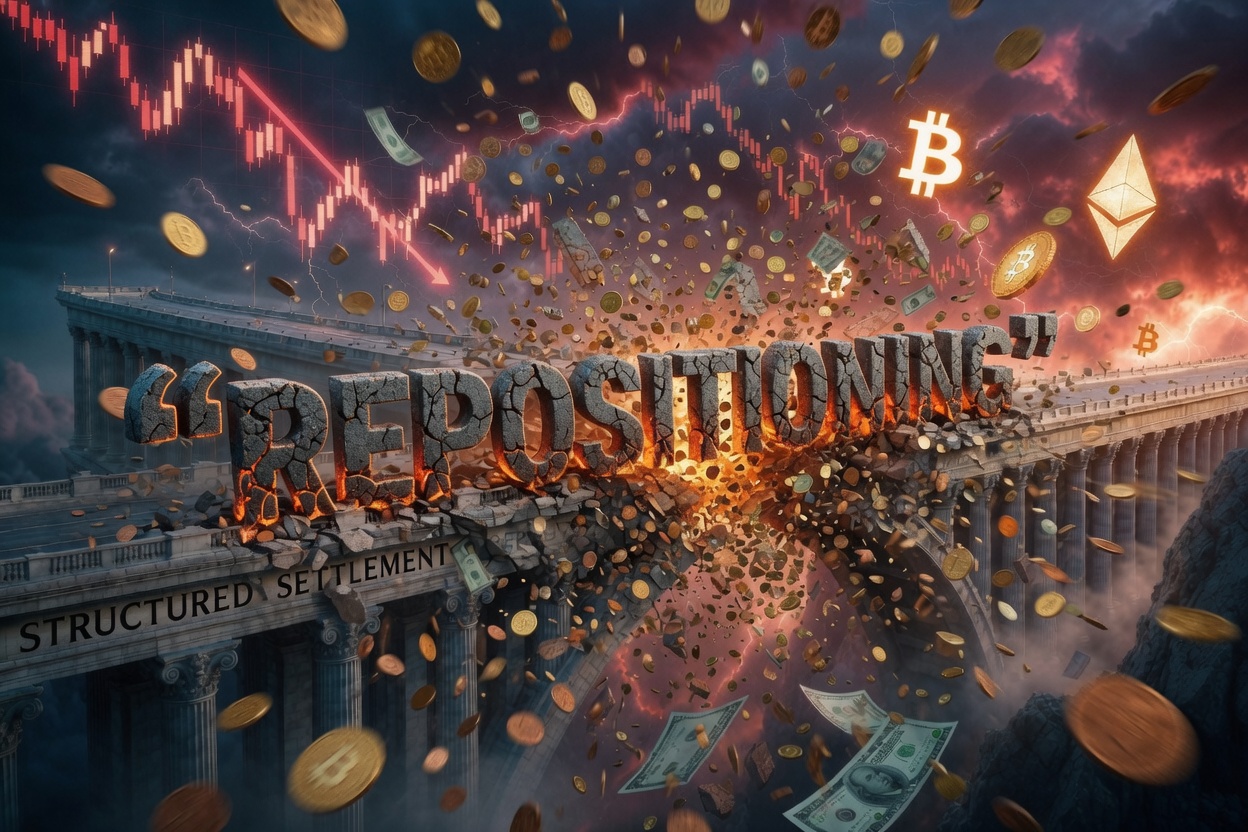
Injury victims and structured‑settlement recipients have always been vulnerable to sales narratives that promise more flexibility, more control, or more “growth” than their guaranteed payments provide. But in the last two years, a new pitch has emerged — one that dresses up liquidation as strategy and speculation as sophistication. And with crypto now down 45–67%, the consequences of that pitch are becoming painfully clear.
🔹 The 2025 “Bridge to Bitcoin” Pitch
In August 2025, a Florida company issued a national BusinessWire press release promoting what it called a “bridge to Bitcoin” for structured‑settlement recipients. It purported to be the first to “connect structured‑settlement buyouts with a high‑growth asset,” invoked BlackRock to create FOMO, hinted at inflation to create FORO, and wrapped the whole thing in “new era of wealth‑building” language.
What the press release never mentioned:
- no FINRA license
- no insurance license
- no IAPD record
- no suitability obligation
- no volatility assessment
Yet it was written as if it came from a financial professional.
And even the terminology was borrowed for effect. A real crypto bridge — as any basic crypto reference explains — is a technical, on‑chain mechanism that moves assets between blockchains using smart contracts, validators, wrapping, and interoperability protocols.
What Anthony Cioppa was offering was nothing of the sort. It was simply:
“Sell your stable, tax‑free income stream for pennies on the dollar, then go buy Bitcoin.”
That’s not a bridge. That’s a liquidation followed by a speculative purchase dressed up in fintech.
🔹 The Connecticut Case
In November 2025, a Connecticut man contacted me directly after reading one of my articles. What happened to him followed a familiar — and deeply troubling — pattern. According to his account, when he disclosed his brain injury to the factoring company, a representative told him not to disclose it to the court because it might jeopardize approval. Another company declined the deal after learning of the brain injury. The one that proceeded allegedly coached him into silence. He sold his structured settlement payments in March 2025, moved into crypto, and by November 2025, the money was gone. Structured Settlement and Cryptocurrency: A Cautionary Tale – Structured Settlements 4Real®Blog December 17, 2025
For clarity, I have no evidence that Cioppa, AAS, or any other entity referenced in this post had any involvement in that case.
The issue is not who participated. The issue is the pattern — especially when the people most vulnerable to harm are the ones being encouraged to “reposition.”
🔹 The April 2026 Warning
On April 4, 2026, I wrote “ From Bridge to Bitcoin to $337M Daily Losses: Less Than a Year Apart” to describe a mindset — the belief that selling guaranteed payments at a discount to chase speculative upside is somehow a “strategy.” It was a warning about the psychology, not the actors.
What I did not expect was to see that same psychology formalized in a national sales blog post.
🔹 The American Annuity Funding Discovery
The American Annuity Funding blog post — published April 2026 — lays out the danger in its own words.
First, it admits the haircut:
- You receive only the present‑day value of your payments
- Future payments “are not worth the full amount today”
- A discount rate reduces them further based on timing and market conditions
That is the loss. That is the haircut.
Then, immediately after acknowledging the loss, the post pivots into investment‑style prompts:
- “Would investing that money create more long‑term growth?”
- “Invest in higher‑return opportunities”
And then comes the tell — the line that exposes the entire psychological mechanism:
“You’re not ‘losing money’ — you’re repositioning it.”
That single word — repositioning — is the bridge. Not to Bitcoin. Not to opportunity. But to rationalizing a guaranteed loss.
It is the same emotional doorway the August 2025 press release pushed people through. It is the same type of doorway the Connecticut man walked through. It is the same doorway countless others are being nudged toward right now.
The AAF blog post blurs the line between the primary structured‑settlement market and the secondary factoring market — exactly the confusion the industry relies on.”
🔹 And Now Crypto Is Collapsing
Crypto is down 45–67%* from the time of Cioppa’s August press release to June 9, 2026. Anyone who “repositioned” their guaranteed payments into speculative assets is now staring at losses that cannot be undone.
The timing could not be clearer.
*depending on a purchase of Bitcoin, buying shares in the IBIT Bitcoin ETF, or stock in Strategy Inc..(NASDAQ: MSTR) a company that has significantholdings of Bitcoins, shown in table in my June 9, 2026 post Structured Settlement to Crypto Bridge is Falling Down? – Structured Settlements 4Real®Blog
🔹 Final Thoughts
Crypto’s unraveling has exposed what the sales language never did. A “bridge,” a “strategy,” or now a “repositioning” doesn’t change the underlying math: a guaranteed, tax‑free income stream is being converted into a discounted lump sum and pushed toward speculative assets at the worst possible time.
The American Annuity Funding blog post didn’t invent this framing — it simply made the subtext explicit. When a guaranteed income stream is reduced to its present‑day value, discounted again, and then marketed as an opportunity to “reposition” into something riskier, the outcome is not innovation. It’s harm.
And as the current crypto downturn shows, the people encouraged to “reposition” are the ones absorbing the losses.
The actors change. The pattern doesn’t. And the consequences, once realized, are irreversible.
Leave a Reply