by Structured Settlement Watchdog
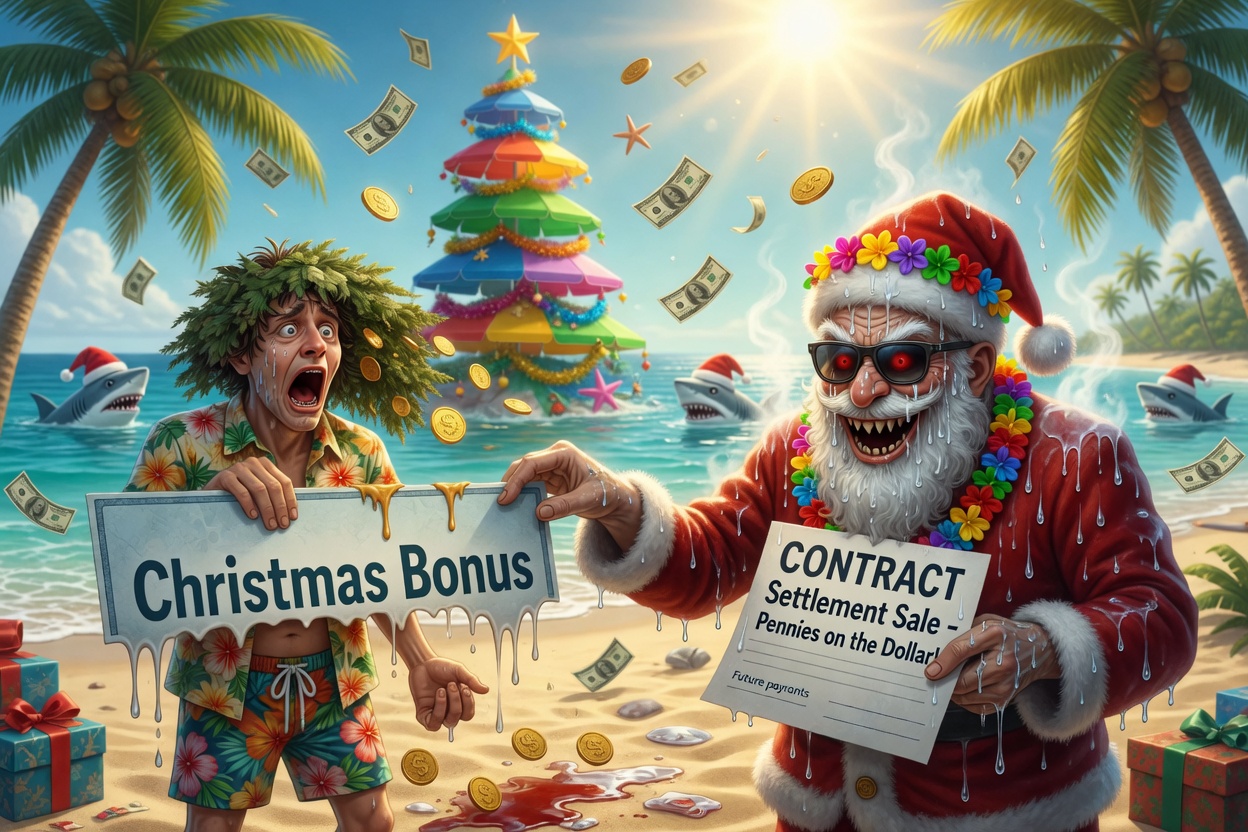
We Pay More Funding has launched a outrageous Christmas Creep scheme on Instagram and Twitter, exhibiting structured settlement secondary market corruption at its worst with this solicitation to annuitants to sell structured settlement payments for pennies on the dollar.
What is Christmas Creep?
Christmas Creep is a somewhat annoying retail phenomenon where holiday decorations and music extend months in advance, well beyond Traditional dates
In Jim Butcher’s 2012 novel Cold Days, even Santa Claus declares that he’s drawing the line at Halloween. One wonders how he might have survived Crazy Eddie’s Christmas in July sales in the mid-1980s.
The double entendre is intentional: “Christmas Creep” is both the retail phenomenon and the creep who Christmas‑creeps annuitants with a bonus conditioned on accepting a pennies‑on‑the‑dollar deal.1980s.

We Pay More Funding’s Questionable Inducement
We Pay More Funding states in an Instagram post September 2, 2018 that they will pay you a cash bonus if you accept their offer. The quoted offer speaks for itself: a cash bonus contingent upon accepting their pennies on the dollar offer. The accompanying table outlines how regulators distinguish a gift from an inducement. There is something ethically and morally wrong with what We Pay More Funding is doing in my opinion. It’s an inducement, not a gift, no matter how much holiday tinsel they drape over it.
What is Difference between Bribery and a Gift?
| Category | Bribery | Gift |
|---|---|---|
| Intent | To influence a decision or steer business for the giver’s benefit | To show appreciation or goodwill with no expectation of action |
| Condition | Contingent on taking a specific action (e.g., “accept our offer and get a bonus”) | Not contingent on any decision; no quid pro quo |
| Timing | Offered before a decision to sway the outcome | Given after a transaction or unrelated to any pending decision |
| Regulatory View | Considered an inducement; prohibited in insurance/annuity contexts | Permissible if reasonable, disclosed, and not tied to a decision |
| Effect on Judgment | Can distort comparison shopping or pressure a vulnerable consumer | Does not impair independent decision‑making |
| Transparency | Often disguised as a “bonus,” “perk,” or “special incentive” | Open, customary, and easily disclosed |
| Structured Settlement Example | “Cash bonus if you accept our pennies‑on‑the‑dollar offer.” → Inducement / Bribe | A modest, non‑contingent thank‑you gesture → Gift |
Who is We Pay More Funding?
Fort Lauderdale based We Pay More Funding LLC is run by Rhett Wadsworth, an individual with the ignominy of being in a cover story in the Washington Post concerning allegations of abuse in the Terrence Taylor case in December 2015.
Sources on Bribes, Inducements & Gifts
1. NAIC Unfair Trade Practices Act (Model #880)
Prohibits offering “any rebate of premium or any valuable consideration not specified in the policy” as an inducement to influence an insurance or annuity decision. Relevance: A “cash bonus if you accept our offer” is the textbook definition of a contingent inducement.
2. NAIC Journal of Insurance Regulation (2025)
Explains that anti‑rebating laws exist to prevent financial inducements that distort consumer judgment and create unfair discrimination. Relevance: Shows why inducements are dangerous for annuitants — they interfere with independent decision‑making.
3. FINRA Rule 3220 — Gifts, Gratuities & Non‑Cash Compensation
Limits gifts to $100 per person per year and bans anything intended to influence a business decision. Relevance: Even in securities, regulators draw a bright line between gifts and inducements.
4. American Bar Association — “The Unlawful Inducement Rule in Insurance” (2025)
A 50‑state survey confirming that inducements — anything of value contingent on a transaction — are prohibited across insurance jurisdictions. Relevance: Supports your point that a contingent “bonus” is not a gift; it’s an inducement.
5. Black’s Law Dictionary — Definition of Bribery
Defines bribery as offering something of value to influence the actions of someone in a position of responsibility. Relevance: Contingency + influence = bribery. Exactly the structure of the offer you quoted.
6. Federal Sentencing Guidelines — Bribery & Gratuities (§2C1.1)
Distinguishes between a bribe (something of value given to influence an action) and a gratuity (a gift given after the fact). Relevance: Mirrors your table — and reinforces that timing and contingency matter.Authoritative Sources
1. “Christmas Creep” — Retail & Marketing Literature
Source:
- The Atlantic — “The Creepy Science of Christmas Creep” (2014)
- Time Magazine — “Why Christmas Decorations Show Up Earlier Every Year” (2017)
- Journal of Consumer Research — Studies on seasonal marketing acceleration
Use in your post: Supports the idea that holiday imagery is pushed earlier and earlier — which your image satirizes by showing Christmas paraphernalia on a beach with sharks in Santa hats.
2. Inducements / Rebating in Insurance & Annuity Transactions
Source:
- NAIC Unfair Trade Practices Act (Model #880) — prohibits offering anything of value as an inducement to influence an insurance or annuity decision.
- ABA — “The Unlawful Inducement Rule in Insurance” (2025) — confirms inducements are prohibited across jurisdictions.
- FINRA Rule 3220 — limits gifts and bans inducements intended to influence decisions.
Use in your post: Directly supports the “cash bonus” element in your image — the melting “Christmas Bonus” sign is a visual metaphor for an unlawful inducement.
3. Predatory Financial Marketing / Vulnerable Consumers
Source:
- Consumer Financial Protection Bureau (CFPB) — Reports on deceptive financial inducements and marketing to vulnerable consumers.
- Federal Trade Commission (FTC) — Guidance on unfair or deceptive acts and practices (UDAP).
- GAO Reports on structured settlement factoring abuses (e.g., the Terrence Taylor case).
Use in your post: Reinforces the “pennies on the dollar” contract in the image and the sharks circling — a metaphor for predatory actors in the secondary market.
4. Structured Settlement Factoring Abuses
Source:
- Washington Post (Dec. 2015) — “How companies make millions off low‑income people with disabilities” (Terrence Taylor case).
- Maryland Attorney General Reports — Enforcement actions against abusive factoring practices.
- Virginia Legislature Hearings — Testimony on predatory structured settlement transfers.