Structured Settlements 4Real®Blog 2026

Structured settlements expert John Darer reviews the latest structured settlements and settlement planning information and news, and provides expert opinion and highly regarded commentary. that is spicy, Informative, irreverent and effective for over 20 years.

  • A Socratic Exploration: Why “Restructuring Policies” Is Inaccurate in Structured Settlements

    Language does work before a court ever does. If a phrase makes a sale sound like a product redesign, people will treat it as a redesign. Start there.

    Restructuring policies in the secondary market

    What exactly does that mean?

    If the answer is “we change your insurance contract so the payments fit your life better,” pause. That is a claim about the policy. Structured settlements almost never work that way.

    First Question: What is the policy?

    A structured settlement is usually funded with an annuity. That annuity is a contract between an issuer (a life insurer) and an owner. After a qualified assignment, the owner is typically a qualified assignment company, not the injured person. The injured person—the payee—owns something else: the right to receive the scheduled payments. Source: 4structures.com

    So ask:

    • Who is named as owner on the annuity?
    • Who has the contractual power to change premiums, riders, commuted value, or payment dates inside that contract?
    • If the payee cannot endorse the policy, surrender it, or rewrite its schedule, in what sense is it “their policy”?

    Second question: What actually moves in a secondary market deal?

    Federal and state law do not describe these transactions as policy rewrites or restructuring. They describe a transfer of structured settlement payment rights—a sale, assignment, pledge, or other alienation of the right to be paid, for consideration. That is the definition of a structured settlement factoring transaction right in the Internal Revenue Code of 1986, as amended, at IRC § 5891. Court approval under a state Structured Settlement Protection Act is required so the buyer can avoid a 40% federal excise tax.

    The insurer generally keeps issuing the same annuity. The assignment company generally still owns it. A court order redirects some or all of the checks. The product is not rebuilt. A receivable is sold. Industry commentators who track this distinction put it bluntly: secondary-market “annuities” offered to investors are not transferred policies; they are assigned payment streams.

    • If the policy is unchanged, what was “restructured”?
    • If only the payee changed for certain dates, why not say “sale of payment rights”?
    • If a judge must find the transfer in the payee’s best interest, why borrow the vocabulary of corporate refinance instead of the statute’s vocabulary?

    The original design is meant to be rigid. Tax treatment under the periodic-payment rules depends on the payee not having constructive receipt of the funding amount and not treating the stream as a freely cashable asset. Payment dates and amounts are locked when the settlement is papered. In the United States you can, with court approval, sell rights. You do not get a quiet mid-course rewrite of the funding annuity as if it were a flexible personal policy. Canadian structures are even more explicit: once in place, the schedule is not changed. See Can You Cash in or Factor Canadian Structured Settlements? – Structured Settlements 4Real®Blog April 30, 2024

    Restructuring a policy” is language from insurance rehabilitation, policy exchanges, or ordinary consumer annuities the owner actually controls. It does not describe a court-supervised factoring of settlement receivables.

    A sale at a discount is easy to understand and easy to fear. Discount rates in this market commonly run in a wide band, often cited around 9% to 18%, and the lump sum is always less than the face total of the payments sold. bankrate.com

    The phrase suggestsThe transaction usually is
    The insurer is adjusting your contractThe insurer’s contract stays put
    You are redesigning a product you ownYou are assigning rights you own
    Flexibility inside the original dealA new contract (not an annuity contract) with a buyer, plus a court order
    A planning serviceA purchase of future cash flows

    Words that hide the buyer, the discount, and the irreversibility after a final order are not neutral. They are positioning.

    • Structured settlement payment rights
    • Transfer or factoring transaction
    • Qualified order
    • Discount rate and aggregate payments transferred versus cash paid
    • Who still owns the annuity?
    1. After this deal, which future checks/electronic deposits still come to me?
    2. What is the total of the payments I am giving up, and what cash do I receive?
    3. Is this my first transfer, or another slice of the same stream?
    4. What happens if I change my mind after the judge signs?

    There are only a few honest answers.

    • It is shorthand used by people who know the difference.
    • It is marketing that prefers “restructure” to “sell.”
    • Or it is confusion—treating the payee as if they held an ordinary annuity they could endorse and amend.
    • Socrates’ method is not to forbid commerce. It is to refuse a name that does not fit the thing. A company may buy payment rights. A court may approve the transfer. An insurer may keep paying on the original schedule to a new address. That is a lawful market with a long paper trail.
    • It is not the restructuring of a policy.

  • Corinthian Museum of Content Barfing — News Flash

    In a development that has prompted a discreet tightening of ascots throughout the Corinthian Museum of Content Barfing, SettlementDecisions has secured an unprecedented second same‑week induction into the Corninthian Museum of Content Barfing Hall of Fame.

    The misspelled title is deliberate, ensuring the work remains wholly non‑adjacent to any SEO benefit, and cannot be misconstrued as legitimate structured‑settlement guidance.

    The track was composed about SettlementDecisions, following their repeated and very public confusion of the qualified assignment company and the payee, a foundational error plainly visible on their homepage.

    During the induction ceremony, the Museum’s ceremonial turntable was activated, sending the record spinning with a cavalcade of clown cars orbiting the platter — a traditional Corinthian gesture reserved for only the most spectacular instances of conceptual content barfing.

    Museum Curator Upchuck Hurlingham III, speaking from the Corinthian rostrum with his trademark air of cultivated disappointment, issued the official statement:

    “While the Museum maintains a certain Corinthian dignity, we cannot ignore the opportunity to exhibit specimens of content barfing. SettlementDecisions has achieved a velocity of misunderstanding that demands immediate enshrinement.”

    Outside the Museum’s marble portico, the terrace‑style supporters — depicted in Exhibit 7B with soccer‑ball heads — continue their chant:

    “You don’t know what you’re doing.”

    The chant is led by KNOBHEAD 81, delivering the authentic terrace sequence — oy → fist up → royt — with full conviction, providing the appropriate sonic accompaniment to the exhibit.

    Further Corinthian commentary will be issued only if SettlementDecisions produces additional content barfing, which precedent suggests is exceedingly likely.

  • SettlementDecisions Episode 5: What SettlementDecisions Really Is — A Lead Funnel, Not an Information Source

    SettlementDecisions presents itself as an educational resource, but the structure and sequencing of its content make the real purpose obvious: it is sales copy designed to generate factoring leads, dressed up to look like information.

    The “education” is superficial by design. A single basic definition is offered to create the appearance of neutrality, and then the reader is immediately steered toward selling their payments. Nothing develops beyond surface‑level explanation because the goal isn’t to inform — it’s to move the reader into a commercial pathway.

    SettlementDecisions is a lead‑generation funnel for structured settlement factoring. Not an educational site. Not a consumer resource. Not independent.

    Everything else is camouflage.

    This post breaks down the funnel step‑by‑step, using SettlementDecisions’ own page content as evidence

    1. The “Education” Is Just a Setup for Selling

    SettlementDecisions begins with a single piece of legitimate information:

    “A structured settlement is…” (definition varies by page)

    And then — immediately — pivots to:

    “Can you sell your payments?” “Yes — you can sell your structured settlement payments…” “Get a free quote…” “Call free — talk to a specialist…”

    This is not how legitimate educational content behaves.

    A real educational resource:

    • explains
    • contextualizes
    • compares
    • warns
    • cites
    • teaches

    SettlementDecisions:

    • defines
    • pivots
    • funnels
    • converts

    The “education” is not education. It is priming.

    2. The Site Is Structured Like a Sales Funnel — Not a Guide

    Every page follows the same pattern:

    Step 1 — Establish credibility

    Tables, timelines, issuer names, discount ranges, AM Best ratings. All designed to create perceived expertise.

    Step 2 — Build trust

    Reassuring language:

    “Your guarantees did not change.” “This was not a sale to a third party.”

    Step 3 — Transition to selling

    “Before requesting a quote…” “Here is the standard timeline…”

    Step 4 — Conversion strike

    “Get a Free Quote → No obligation. No credit check.” “Response within 24 hours.”

    Step 5 — Kill zone

    “Call free — talk to a specialist (866) 312‑9858.”

    This is textbook funnel architecture.

    Not education. Not neutrality. Not independence.

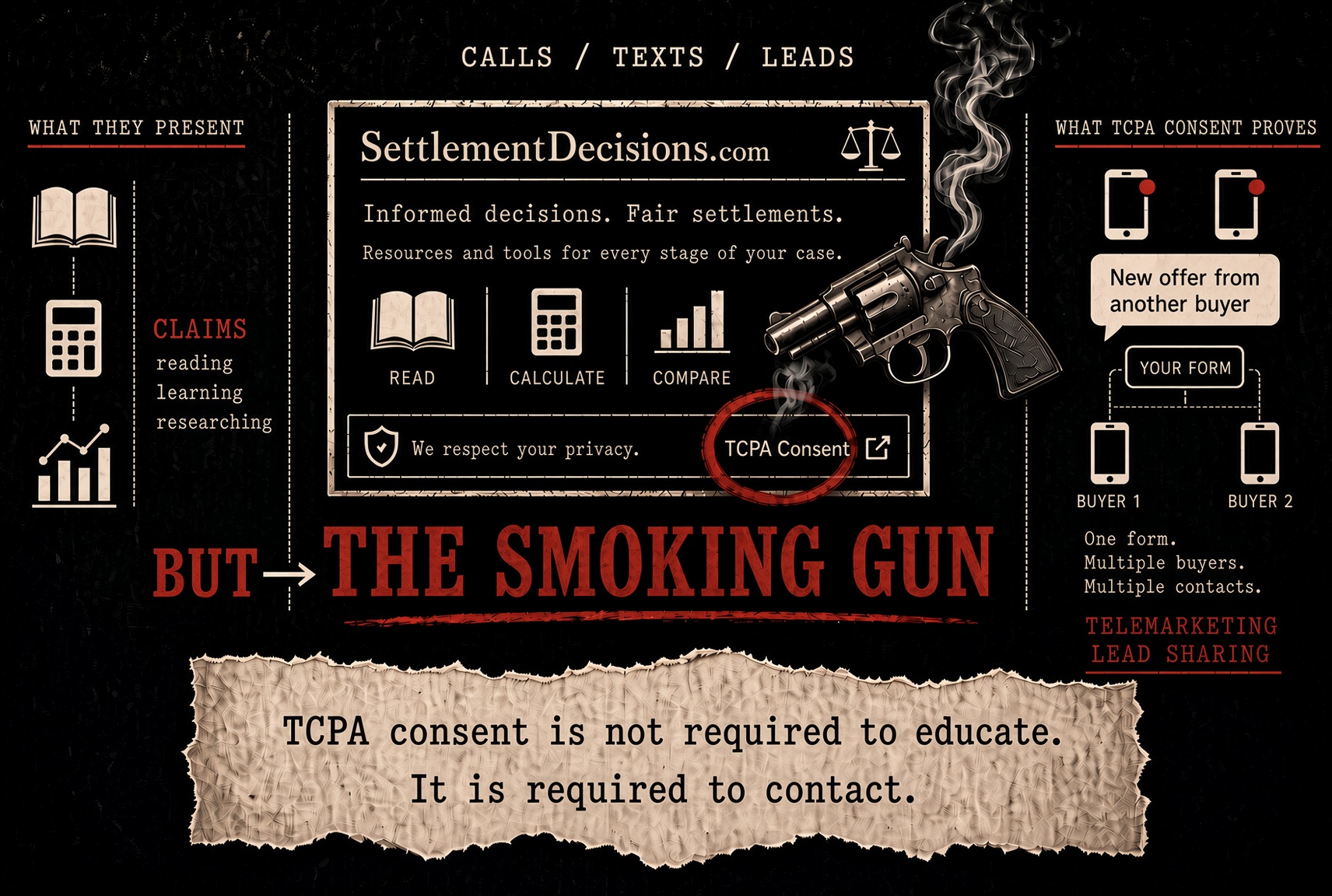
    3. The TCPA Disclosure Reveals the True Intent

    At the bottom of the page:

    “TCPA Consent”

    This is the smoking gun.

    TCPA consent is not needed for:

    • reading
    • learning
    • browsing
    • researching
    • comparing
    • understanding

    TCPA consent is needed for:

    • telemarketing
    • lead sharing
    • repeated calls
    • repeated texts
    • data distribution
    • multi‑buyer feeding

    The presence of TCPA consent proves the site’s purpose:

    SettlementDecisions is designed to collect leads and permission to contact them.

    Not to educate them.

    4. The “Holder” Misnomer Is Psychological Manipulation

    The newsletter pitch:

    “Join 10,000+ holders.” “Rate alerts, negotiation tips & market updates…”

    Payees are not “holders.”

    They do not hold:

    • annuities
    • accounts
    • negotiable assets
    • marketable instruments

    They hold payment rights.

    Even the language choices serve the commercial objective. Calling payees “holders” is not an industry term; it’s a psychological device to keep readers engaged as potential sellers. Every element — terminology, structure, sequencing — is optimized for lead capture rather than consumer understanding.

    • It makes them feel like they own something.
    • It makes them feel like they can “manage” something.
    • It makes them feel like they can “optimize” something.
    • It keeps them engaged in the funnel.

    This is not education. This is lead conditioning.

    5. The “Independent, Unbiased, Always Free” Claim Is Camouflage

    The footer claims:

    “Independent, unbiased, always free.”

    But the site:

    • funnels
    • converts
    • captures
    • calls
    • texts
    • emails
    • shares data
    • routes leads

    Nothing about this is independent. Nothing about this is unbiased. Nothing about this is free.

    It is a commercial lead‑generation engine.

    6. Sales Copy for Structured Settlement Factoring Lead Generation Wearing an Educational Costume

    Every piece of information on the site — even the accurate ones — serves a single ulterior motive:

    Get the reader to call, text, or submit their information.

    Examples:

    Legitimate info:

    “Life‑contingent payments carry mortality risk.”

    Ulterior motive:

    “Get a free quote.” “Call free — talk to a specialist.”

    Legitimate info:

    “Court approval is required under your state’s SSPA.”

    Ulterior motive:

    “We handle all court filings.” “Response within 24 hours.”

    Legitimate info:

    “Discount rates typically range from 9–18%.”

    Ulterior motive:

    “Get Your Free Quote → No obligation.”

    In short, SettlementDecisions is structured settlement factoring sales copy wearing an educational costume. The information is merely a pretext. The commercial motive is the product.

    7. What SettlementDecisions Really Is

    Let’s say it plainly:

    SettlementDecisions is a structured settlement factoring lead funnel. Every page, every sentence, every CTA, every “guide,” every “insight,” every “tool,” every “market update” exists to generate leads.

    The site’s purpose is:

    • capture
    • warm
    • convert
    • contact
    • route
    • monetize

    Not educate.

    Episode 1 — Manufactured Authority (SettlementDecisions ↔ DSF)

    The circular authority loop is already proven. No need to re‑prove it here.

  • Structured Settlement Annuity Guarantees Help Financial Peace of Mind

    by John Darer CLU ChFC MSSC CeFT RSP CLTC

    A Structured Settlement Annuity is a boring financial creature

    Unabashedly unapologetic for simply providing a sustainable “river of income”, or a river delta that provides multiple streams of income 

    Structured settlements can provide a river of income or the financial equivalent of multiple rivers income delta

    A 2024 AARP survey found that 20% of Americans aged 50 and older have no retirement savings at all, and 61% worry they will not have enough to last. The Census Bureau’s Survey of Income and Program Participation goes further: roughly 50% of women aged 55 to 66 have zero personal retirement savings, compared with 47% of men.   “financial peace of mind” to be a top priority.

    Structured settlements make sense for those older than age 55, including plaintiff attorneys who wish to structure attorney fees.

    The difficulty in living off a “mountain of cash” is to gauge multiple , sometimes unpredictable variables such as life expectancy,  investment risk and extraordinary and unpredictable expenses like the need for custodial care, particularly if long term care insurance has not been purchased and the  individual is uninsurable.

    Structured settlements, structured attorney fees, structured installment sales are financial tools that can give payees, stable , secure, guaranteed cash flow. with tax advantages

    Structured settlements and structured attorney fees can be funded via structured annuities, index based structured settlement annuities, or United States Treasury obligations.

    Structured installment sales,  or structured installment  sales, which help convert real property or business into an income stream can be funded with United States Treasury obligations..

    Where there is no personal physical injury

    Those not seeking current income, in a matter without personal physical injury, physical sickness or wrongful death have an option through a non qualified assignment to MetLife Assignment Company, Inc. using Metropolitan Tower Life’s Funding Agreement.

    Modern digital dollar sign in textured silver against a rich blue background

    Structured Settlements For Seniors and Settlement Planning for Older Age Plaintiffs

     Ol’ man river,
    Dat ol’ man river
    He mus’know sumpin’
    But don’t say nuthin’,
    He jes’keeps rollin’
    He keeps on rollin’ along.

    (Paul Robeson 1898-1976)

    Funding Agreement Structured Settlement for Taxable Damages

    NQA-Flex: Flexibility in Non-Qualified Assignments – Structured Settlements 4Real®Blog 2026

     Lower two Images: Dreamstime.com

    Header Image: AI generated

  • How Sheron Jones Was Exploited — And Why D.C.’s Failure to Mandate IPA in SSPA Enabled It

    The Sheron Jones case remains one of the most troubling examples of how a cognitively‑impaired D.C. resident was stripped of her structured‑settlement payments through a predatory transfer orchestrated by Vintage Equity Group. The July 2025 developments in her federal matter clarified the mechanics of the exploitation — and exposed the regulatory vacuum in the DC Structured Settlement Protection Act that made it possible.

    What Happened to Sheron Jones

    (Jones v. Vintage Equity Grp., 24-cv-3108 (DLF) (D. D.C. Jul 28, 2025)

    Sheron Jones was a severely cognitively‑impaired lead‑paint victim with:

    • a documented IQ in the 50s,
    • a third‑grade reading level,
    • no meaningful employment history,
    • and no ability to understand complex financial transactions.

    Despite this, she was coached into selling 312 months of structured‑settlement payments — her primary source of long‑term financial security.

    Court filings show she did not understand:

    • the payment stream she was giving up,
    • the discount rate,
    • the long‑term consequences,
    • or even the basic mechanics of the transfer.

    Her vulnerability was the reason she was targeted.

    Who Vintage Equity Group Is

    (Insert citation: e.g., “In re Transfer of Structured Settlement Rights of Jones, No. XX‑XXXX (D.C. Super. Ct. 20XX)”)

    Vintage Equity Group is a factoring company that, according to multiple petitions and affidavits, operated a repeat‑player pipeline involving:

    • cognitively‑impaired annuitants,
    • low‑literacy claimants,
    • venue shopping,
    • and extreme discount rates.

    In Sheron’s case, Vintage Equity:

    • initiated the transfer petitions,
    • benefited from the discounted payment stream,
    • issued the checks,
    • and received the structured‑settlement rights.

    The exploitation was not incidental — it was structural.

    What Jones’s Lawyers Contended

    (Insert citation: e.g., “Plaintiff’s Memorandum in Support of Motion for Relief, Jones v. [Defendant], No. XX‑XXXX (D.D.C. 2025)”)

    Jones’s lawyers argued that:

    1. Sheron lacked the cognitive capacity to understand the transaction.
    2. The transfer was engineered through manipulation, coaching, and control.
    3. The perpetrator acted as Vintage’s agent, regardless of formal employment status.
    4. Vintage benefited directly from the exploitation.
    5. The court failed to conduct any meaningful inquiry into her comprehension.
    6. The transaction violated consumer‑protection norms and basic fairness.

    Their core argument:

    Sheron could not legally or meaningfully consent to the transfer.

    Vintage Equity Group’s Attempt to Distance Itself

    (Insert citation: e.g., “Defendant’s Opposition, Jones v. [Defendant], No. XX‑XXXX (D.D.C. 2025)”)

    Vintage’s defense was predictable:

    “The individual who coached her, transported her, opened her accounts, and facilitated the transfers was not Vintage Equity Group.”

    They attempted to portray the perpetrator as:

    • a rogue actor,
    • an unaffiliated helper,
    • someone acting independently,
    • not an agent of Vintage.

    But the filings contradicted this:

    • He represented himself as Vintage.
    • He facilitated Vintage’s petitions.
    • He sat next to Sheron during hearings, muting/unmuting her phone.
    • He transported her to the bank to deposit Vintage’s checks.
    • He added his biometrics to accounts holding Vintage‑originated funds.
    • He initiated transfers out of those accounts.

    Vintage’s distancing strategy collapses under the weight of its own transaction pipeline.

    How Mandatory IPA Would Have Protected Her

    (Insert citation: e.g., “Expert Report of [Name], Jones v. [Defendant], No. XX‑XXXX (D.D.C. 2025)”)

    If D.C. required Independent Professional Advice (IPA), Sheron’s transfer would have been impossible.

    An IPA would have:

    • assessed her cognitive capacity,
    • documented her inability to understand the transaction,
    • explained the discount rate,
    • compared alternatives,
    • flagged the coaching and manipulation,
    • and stopped the transfer cold.

    IPA is the only safeguard that forces a real evaluation of comprehension — something the court failed to do.

    Why D.C. Still Doesn’t Mandate IPA

    Despite cases like Sheron’s, D.C. has not mandated IPA. Reasons include:

    1. Legislative inertia

    Structured‑settlement reform is low‑visibility and rarely prioritized.

    2. Industry lobbying

    Factoring companies oppose IPA because it eliminates their most profitable transactions — those involving vulnerable claimants.

    3. Judicial complacency

    Courts historically believed they could “ask a few questions” and determine comprehension. Sheron’s case proves they cannot.

    4. Misunderstanding of IPA’s purpose

    Some policymakers incorrectly view IPA as “extra paperwork,” rather than a cognitive‑capacity safeguard.

    5. No recognition of downstream harm

    When vulnerable claimants lose their payment streams, they:

    • fall deeper into poverty,
    • lose long‑term financial stability,
    • and become more dependent on public benefits.

    The public ultimately pays for the exploitation.

    The Policy Bottom Line

    Sheron Jones’s case shows exactly what happens when:

    • a vulnerable claimant is targeted,
    • a predatory company benefits,
    • a court rubber‑stamps a transfer,
    • and no IPA is required.

    The July 2025 developments make the conclusion unavoidable:

    D.C.’s failure to mandate IPA directly enabled Sheron’s exploitation — and continues to expose its most vulnerable residents to financial harm and increased dependency on public assistance.

    The Human Consequence

    DC Lead Paint Victim with 56 IQ Exploited by Delaware Structured Settlement Factoring Company Says DC Lawsuit – Structured Settlements 4Real®Blog August 21, 2024

    The Sheron Jones Story was also touched on in the May 17, 2026 episode of Last Night with John Oliver Structured Settlements & Factoring Companies Segment, now posted on YouTube with over 2 million views. The Sheron Jones story appears begining at the 18:33 mark in the 30 minute video and discusses the allegation that the DC Lead Paint Victim was actively coached during the transfer hearing.

    The Recurring Pattern Observed in other States like Connecticut that don’t have Mandatory IPAs

    Structured Settlement and Cryptocurrency: A Cautionary Tale – Structured Settlements 4Real®Blog December 17, 2025 Story of CT Structured Settlement Cash Now to Crypto Disaster for Man with Brain Injury. From Sale of Structure—> Crypto—>Zero in 8 months. CT is among the majority of states that does not Mandate IPAs and should . The man had an obvious brain injury and CT does not madate IPAs which would have caught this.

    Why it’s insufficient and the Sheron Jones case proves it

    D.C. law mandates that a payee be advised in writing by the transferee to seek independent professional advice before a structured settlement transfer, and that the payee either obtain such advice or waive the right to it. The law also requires the payee to be informed of the right to seek independent advice before agreeing to the transfer. This is part of the court’s approval process under § 28A‑105.

    Contrast with California: The Gold Standard for Mandatory IPA in Structured Settlement Transfers Laws

    In California, Independent Professional Advice (IPA) is a mandatory requirement under the California Structured Settlement Protection Act (SSPA) before a structured settlement payee sells their future payment rights .

    What IPA Is (California)

    IPA is advice from an attorney, certified public accountant, actuary, or other licensed professional adviser who:

    • Is engaged by the seller to discuss the legal, tax, or financial implications of the structured settlement or the transfer.
    • Is independent of the buyer or transferee (except referrals through a state or local bar association lawyer referral service).
    • Is not paid based on whether a sale occurs .

    Why an IPA is Required (California)

    The law requires IPA to ensure:

    • The seller receives a fair market value for their future payments.
    • The seller has multiple quotes from different buyers.
    • The seller understands the transaction and its consequences.

    Amount of IPA Fee and Funding (California)

    California’s SSPA mandates that the buyer fund the IPA cost. The law specifies a minimum of $1,500 for IPA in California, separate from any other fees or commissions.

  • Attorney Fee Structured Settlement Factoring

    How Does it Work? Is it even possible?

    Because Attorneys are People Too

    The following survey was provided to me by someone in the secondary market who obtained it from sources within the primary market. The impetus for the survey came from certain settlement consultants who had placed structured attorney fees for certain attorney clients, the attorney clients later wanted to factor and learned they could not.

    This is posted in the spirit of transparency and education. I’m not aware of any of my clients who have factored, or attempoted to factor their attorney fee structured settlement payments. Each company makes its own decisions for its own reasons. This is not a judgment post.

    AmGen: We don’t have any special program for a situation like this. We would treat an attorney factoring his case the same as we would a claimant. He would have to find a company to factor his case through and we would follow the court order.

    Berkshire Hathaway: We don’t have any special program for a situation like this. We would treat an attorney factoring his case the same as we would a claimant. He would have to find a company to factor his case through and we would follow the court order.

    Independent Life: We haven’t yet had any attorney attempt to factor payments. As we are the only life company who cares about the payee in factoring transactions, we have made no decision whether our PPP would apply to attorneys if it fell within the parameters of the policy. I think we would make a decision at the time.

    MetLife: Yes, we do allow attorneys to factor their fee structures provided we receive an order from a court.

    New York Life: Attorneys do not own the annuity and they are not entitled to the PV of payments pursuant to the Convenience Language and Hold Harmless Agreement.

    Pacific Life: We have encountered requests to factor attorney fee payments in the past and have not opposed these requests. Except for the state of West Virginia, which requires a court order even if the payments are taxable.

    The Prudential Insurance Company of America: The Internal Revenue Code, IRC 5891(b)(2) does not allow for Attorney Fees payments to be transferred or sold. Only Claimant’s payment rights are able to be factored/sold under a Qualified Order under IRC 5891(b)(2).

    United of Omaha (MoO): Thank you for reaching out. For all factoring transaction(s) or change of contractual Payee on a qualified structured settlement, Untied of Omaha Life Insurance Company (United) requires a “Qualified Order”. Please remember the attorney does not “own” an annuity and has also signed a hold harmless waiving any rights to the portion of the recovery that is structured qualified attorney fees. United would require a Qualified Order, in good order, to process the approved Court Order making this change of contractual Payee on an issued qualified Structured Settlement Annuity Contract.

    USAA: We have allowed attorney fee factoring in the past. It would be subject to review and approval by our legal team.

    Note: The survey displayed above was provided to me by a professional in the secondary market. I have not independently verified its currency or completeness. Some major current structured settlement annuity issuers — including Athene and American National — do not appear in the survey results. Their absence should not be interpreted as an indication that they are not issuing structured settlement annuities to fund attorney fee structured settlements; it simply reflects the limitations of the data supplied.

  • One Year Later: The Structured Settlement–to–Bitcoin Anniversary Nobody Is Celebrating

    One year ago this week, Bitcoin was trading at $111,802.66.

    On that exact day — August 26, 2025 — Anthony Cioppa, founder of American Annuity Funding, issued a Business Wire press release announcing a new service called Structured Strategy, which he described as “the first to formally connect the established practice of structured settlement buyouts with the cryptocurrency market.”

    The pitch was straightforward: structured settlements are slow, inflation is eating your payments, and Bitcoin is rewriting the wealth-creation playbook. His company would buy your future guaranteed payments at a discount, hand you a lump sum, and help you put that money into Bitcoin.

    That press release went out at 6:12 PM Eastern Daylight Time on August 26, 2025.

    Let’s look at what happened next.

    When someone sells a structured settlement to a factoring company, they don’t get dollar-for-dollar value. Courts require approval, but that doesn’t stop the discount. Sellers typically receive 50 to 70 cents on the dollar for their future payments — sometimes less.

    So that $100,000 structured settlement became roughly $60,000 in cash. Then, swept up in the FOMO of a Bitcoin ATH, that $60,000 went into BTC or IBIT.

    Here’s where the numbers stood on August 26, 2025 — right at the peak of the FOMO window: when Anthony Cioppa took out national press releases

    AssetAug 26, 2025 Price
    BTC$111,802.66
    IBIT$63.10
    MSTR$351.36

    By March and April of 2026, those positions were down nearly 50%. Not 30%. Not 20%. Half.

    Imagine watching $60,000 shrink to $30,000 — knowing that the structured settlement you gave up was still sending guaranteed checks to the factoring company that bought it. The psychological pressure to sell, to stop the bleeding, was immense.

    This is the moment FOMO flips. The same fear that drove people in at the top drove people out at the bottom.

    Let’s say someone was disciplined. Exceptional, even. They held through the 50% drawdown and didn’t sell at the bottom.

    Here’s where those same assets stood one year later, on August 26, 2026:

    AssetAug 26, 2025 Price
    BTC$111,802.66
    IBIT$63.10
    MSTR$351.36

    BTC and IBIT are down roughly 30% from the day the FOMO was loudest. MSTR — often pitched as “leveraged Bitcoin exposure” — is down nearly 65%.

    Now run that through the full structured settlement scenario:

    StageValue
    Original guaranteed settlement$100,000
    Cash received after factoring discount~$60,000
    Value after 30% crypto drawdown (best case)~$42,000
    Total real-world loss~$58,000 — 58%

    A structured settlement isn’t an investment. It doesn’t go up or down. It doesn’t have drawdowns. It isn’t subject to market sentiment, ETF flows, or what happens on a Tuesday in March.

    It is a contractual guarantee — periodic payments, often tax-free, often judgment-proof, designed specifically to protect people who need financial stability.

    That certainty has enormous value that never appears on a price chart. It’s precisely what the factoring industry needs you to stop thinking about in order to complete the transaction.

    The people who resisted the FOMO one year ago — who kept their structured settlements intact — didn’t lose a penny. Their payments kept coming.

    The people who sold at the peak are, at best, sitting on $42,000 of a $100,000 guarantee. Many are sitting on far less.

    If you’re being approached about selling your structured settlement — for any reason, crypto or otherwise — get independent professional advice before you sign anything. The discount is permanent. The pitch isn’t.

    Data sources: BTC and MSTR historical closes; IBIT Aug 26, 2026 close via Seeking Alpha; IBIT Aug 26, 2025 close from prior research dated 6/24/2026.

    A final tasting menu from today’s investigative kitchen:

    • Risotto al Rischio — slow‑stirred speculation with a generous ladle of misplaced confidence.
    • Calamari di Compliance — rings of regulation, lightly breaded and mostly ornamental.
    • Cioppa de Pesce — the signature finish, served with a bright squeeze of lemon for anything that still smells a little… off.
    • In an X post on August 6, 2026, Anthony Cioppa now says that “clarity would never happen at the bottom of the bear market” — an interesting bit of hindsight given that he was recommending repositioning structured settlements into crypto back in August 2025, well before the bottom he’s referring to. The timing speaks for itself.
    Structured settlement watchdog a Black French Bulldog clad in a balck tuxedo, bowtie and blue aviatior sunglasses with a martini sandwisching desk name plates FOMO and FORO also on the bat is a pyramid of pennies on the dollar and a bitcoin and a bitcoin broken bu 2/3 representingb bitcoinb loss over the course of one year. Other bar lements inlcude a liquor display and  a menu board which features bstaurual menu item sfrom the investigative kitchen like  Cioppa De Pesce, calimar di Complaunce and Risotto del Richio
  • SettlementDecisions Episode 4: Purports to be a Directory-Delivers Spam Instead

    SettlementDecisions.com purports to be a “neutral, fact‑based directory of every active structured settlement buyer in America” . But several of the listings only purport to be real companies — and the phone numbers assigned to them prove the directory is not just inaccurate, but functionally useless.

    Here are the most glaring examples directly from the page:

    • Rightway Funding — To underscore how useless SettlementDecisions.com has been in this four‑part series, I added the actual BBB listing for Rightway Funding. The real company Rightway Funding, LLC. | BBB Business Profile | Better Business Bureau Their real number, as shown on the BBB page, connects to a real business with a real rating — not to a spam boiler room. Compare that to the number SettlementDecisions assigns them, (800) 555‑0199, which doesn’t reach Rightway at all. It routes callers to America’s Hottest Talk Line (“Guys press 1, ladies press 2”). When a directory replaces a legitimate company’s real contact information with a phone‑sex line, it stops being a resource and becomes digital waste. This is the fourth installment in our review, and so far SettlementDecisions.com has proven to be utterly useless.
    • MainStreet Funding — (800) 555‑0156. Routes callers to beach vacations, cheap flights,a nd hotel rooms. Classic inducement spam..
    • Settlement Capital Corp — (800) 555‑0134 Pushes free medical alert devices — the same robocall sludge consumers get daily.
    • Glofin Funding — (800) 555‑0190 Lands in the same boiler‑room ecosystem.
    • American Settlement Funding — (800) 555‑0167 Placeholder number, not a business line.
    • Client First Settlement — (800) 555‑0145 Another 555 number — more spam routing.
    • Annuity Transfers (Plano, TX) — (800) 555‑0132 Doesn’t connect at all. Just a dead line. The company is closed.

    These are 555-series placeholders, never used by regulated financial services firms. Yet the directory presents them as legitimate contact numbers for companies it claims are “active” and “verified.”“After discovering that SettlementDecisions.com assigns 555 numbers — the same fictional placeholders used in movies and TV — to real structured settlement companies, the conclusion is obvious: this tool isn’t just inaccurate, it’s imaginary. With that, we’ll leave the file open and move on to the work that actually matters.”

    Meanwhile, the same page warns consumers to avoid companies with “no BBB listing” — while listing multiple Not Rated BBB profiles as if they were vetted.

    And it places a defunct company (SenecaOne) in the same ecosystem, explicitly marked “DEFUNCT” .

    At this point, the conclusion is unavoidable:

    **SettlementDecisions.com isn’t a directory.

    It’s digital debris — skid marks on the underwear of the internet.**

    SettlementDecisions clogs search results, misleads consumers, and routes callers to spam, dead numbers, inducement boiler rooms, and even phone‑sex lines.

    If a platform doesn’t care about accuracy, no consumer should care about its recommendations.

  • Settlement Decisions: Settlement Apparition of the Week

    Another Farcical on a Popsicle Stick

    for the dog days of August followed by parallel ions, parallel icles

    A full‑page “comparison” that kicks off with Strategic Capital vs. Woodbridge Structured Funding: Who Pays More in 2026? and then immediately warns you that Woodbridge has been gone since 2019, essentially gone since 2017.

    So what they’re really staging is a kickoff… against kicking the bucket on The Lawn of the Dead — that sun‑bleached field where ghost companies lie in permanent overtime and the only thing moving is a popsicle stick wobbling in the August heat.

    It isn’t analysis. It’s necromancy.

    Embarrassing for these twits.

  • Metropolitan Life Insurance Company: Back to the Future for MetLife Structured Settlements

    Great News from MetLife Structured Settlements

    Metropolitan Life Insurance Company is now lead Structured Settlement Annuity Issuer for Qualified structured settlement cases

    The return to Metropolitan Life Insurance Company as MetLife’s primary structured settlement annuity issuer, for the first time since May 3, 2017, is a welcome development. For several years Metropolitan Life Insurance Company was an option on a case by case or basis, or when a case reached a certain premum threshold.

    Metropolitan Life Insurane Company has been in business since March 24, 1868. Andrew Johnson was the U.S. President and Ulysses S. Grant would be elected in the Fall of that year.

    What Is Not Changing? 

    Non Qualified Structured Settlement Business with MetLife

    The following business will continue to be issued through Metropolitan Tower Life Insurance Company (MTL) with MetLife Assignment Company, Inc. (MACI) as the assignment company: Non-Qualified Assignments, Structured Installment Sales  All Non Qualified Assigment Flex (NQA Flex) Agreement cases (non qualified assignments with a funding agreement instead of an annuity)